
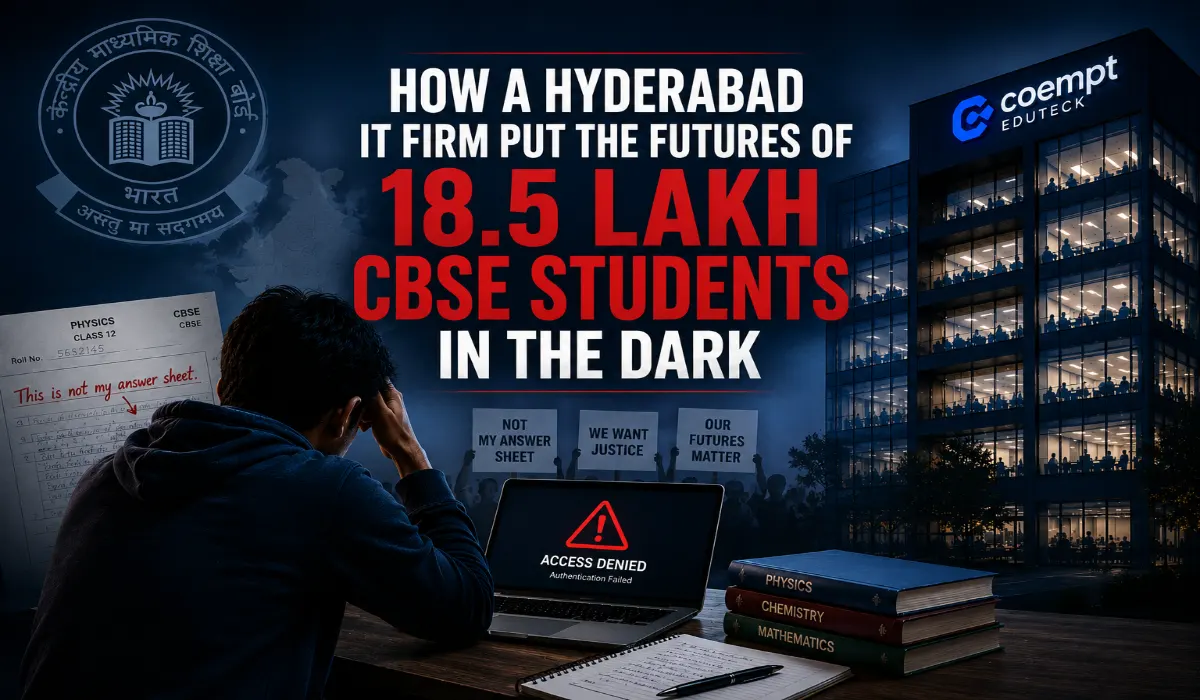
Before Vedant Srivastava became a national headline, he was just a 17-year-old Delhi student who did everything right. He discovered a deeply disturbing problem, the Physics answer sheet sent to him by CBSE during re-evaluation belonged to someone else entirely. The handwriting, structure and presentation were completely different from his own.
So Vedant did what any student is supposed to do. He contacted CBSE through official channels, multiple email IDs, helpline numbers and contact details listed on the board’s own website. He wrote to them. He called. He waited.
CBSE went completely silent. Not a single acknowledgement. Not one email reply. Not one callback. Every official channel failed him.
Exhausted and with his future on the line, Vedant did the only thing left. On May 23, 2026, he posted on X (formerly Twitter), sharing images of the mismatched answer sheet with the caption: “not my answer sheet.”
How Vedant’s fight unfolded, let’s understand it step by step
1. Requested a scanned copy of the Physics answer sheet via CBSE’s official re-evaluation process, and he paid the prescribed fee. Followed the process correctly.
2. Received a scanned copy, but it was someone else’s answer sheet. Handwriting, structure and style are completely different from his own.
3. Contacted CBSE via multiple official email IDs, helpline numbers and contact details; CBSE did not reply. Not once.
4. With no official response, posted publicly on X on May 23, 2026. His post went viral. Thousands of students and parents piled on with similar complaints.
5. CBSE responded, but only after the internet forced their hand (May 25): “Dear Vedant… the correct copy of your answer book has been sent to your registered email address.”
The board that had ignored every official complaint treated the matter as a “top priority” the moment it went viral. A dedicated CBSE team was reportedly deployed to monitor social media complaints, a unit that apparently did not exist to handle the same complaints through official channels.
The trolling that followed
When Vedant’s post exploded online, not everyone offered support. Because his newly created X account displayed “South Asia” as his location, a default technical glitch during account setup, sections of the internet accused him of being Pakistani and of deliberately trying to tarnish CBSE’s reputation. The 17-year-old, who had done nothing but fight for his own answer sheet through legitimate means, found himself subjected to targeted harassment and abuse.
Vedant’s brother Siddhant Srivastava eventually hit back on social media, posting a family photograph with the message: “Rajma chawal after such a hectic day. Big thanks to all who supported us… and we are not Pakistani.” The family was vindicated when CBSE formally acknowledged the mapping error in its On-Screen Marking system.
A student who discovered a systemic failure in India’s national examination board attempted every official remedy, was ignored, went public, was trolled as a foreign agent, and was ultimately proven completely right. This is the story of CBSE’s 2026 digital overhaul.
Coempt EduTeck Private Limited
Formerly Known As: Globarena Technology Pvt. Ltd.
| Particulars | Details |
|---|---|
| Company Name | Coempt EduTeck Private Limited |
| Former Name | Globarena Technology Pvt. Ltd. |
| CIN | U72200TG2000PTC034224 |
| Registration Number | 34224 |
| Incorporated | 2000 (as Globarena Technology Pvt. Ltd.) |
| Company Type | Private Limited Company |
| Industry | Education Technology / Digital Assessment Solutions |
| Head Office Address | Plot No. 8-3-224/4/C, F-28, Madhuranagar, Yousufguda, Hyderabad, Telangana – 500038 |
| Official Website | www.coempt.in |
| Official Email | accounts@coempt.in |
| Employee Strength | 51-200 employees |
| Flagship Product | OnMark OSM Platform |
| Core Services | Online Examination Systems, On-Screen Marking (OSM), Digital Evaluation Solutions, Assessment Technology |
| Board of Directors | Information not publicly specified in the provided details |
This is the company that currently manages the digital backbone of CBSE’s national examination evaluation system – handling the scanned answer scripts of over 18.5 lakh students across India. Despite this extraordinary responsibility, CBSE has never publicly named or confirmed Coempt EduTeck as its vendor. The connection was uncovered by a 19-year-old hacker probing the portal’s code.
The company describes itself on its website as a provider of “end-to-end examination solutions” with “20+ years of experience in providing technology solutions in the education sector.” The flagship product, OnMark, is what powers CBSE’s OSM system. What the website does not mention is the company’s previous incarnation, Globarena Technology, and the disasters that name carried.
A trail that should have disqualified them
2019: Telangana Intermediate Board Disaster
Operating as Globarena Technology, the company was linked to catastrophic result errors in the Telangana Intermediate Board examinations. Mass result anomalies caused devastating mental trauma among students and their families. Twenty-three students are reported to have died by suicide in the aftermath. The company was questioned over its execution and subcontracting practices. Congress leader Rahul Gandhi later alleged that errors in the on-screen marking system directly contributed to these deaths.
Post-2019: CHSE Odisha Plus II
The company surfaced again in scrutiny over the CHSE Odisha Plus II digital e-evaluation project, drawing further questions about its technical capabilities, execution standards and reliance on subcontracting.
Rebranding, Globarena becomes Coempt EduTeck
Globarena Technology Pvt. Ltd. was rebranded as Coempt EduTeck Private Limited. The corporate identity changed; the directors, the address, the products and, critics now allege, the underlying problems did not.
2026: CBSE Class 12 National Fiasco
Now holding the CBSE contract, Coempt EduTeck’s OnMark platform is at the centre of swapped answer sheets, a portal with hardcoded master passwords accessible to anyone, and a system whose security a teenager broke in under an hour. 18.5 lakh students are caught in the crossfire.
The teenager who cracked the portal open
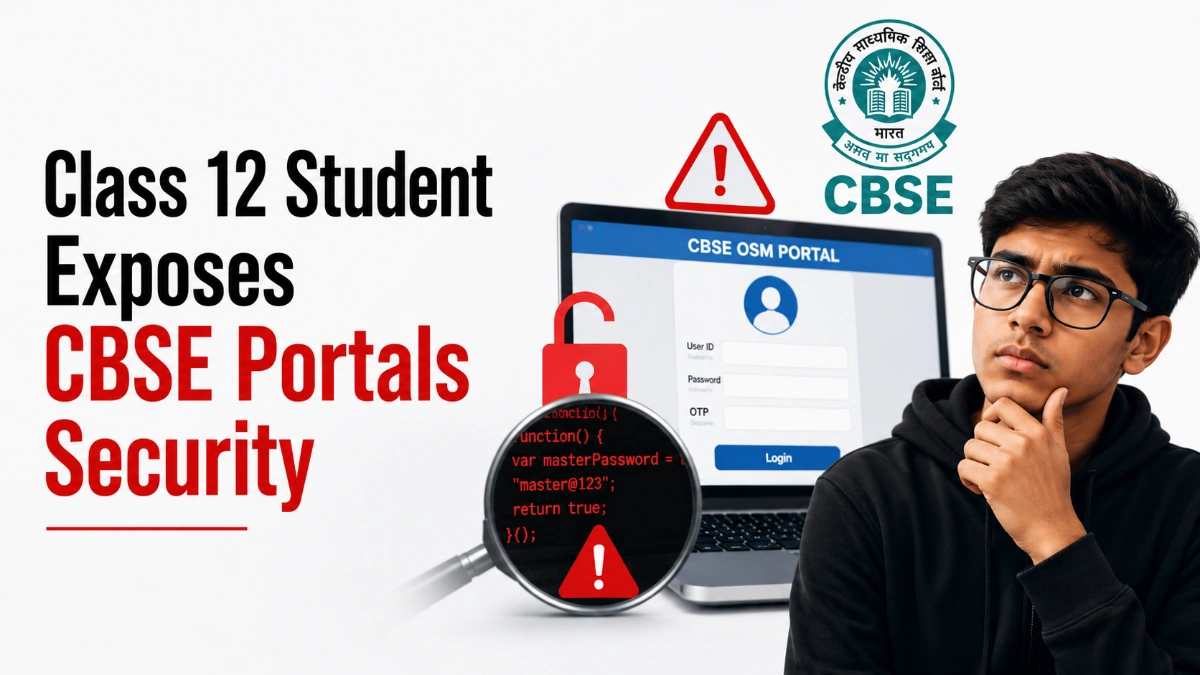
Nisarga Adhikary, a 19-year-old Class 12 student and ethical hacker from Bengaluru, began examining CBSE’s OSM portal out of pure curiosity after its launch in February 2026. Within 30 minutes, he had identified a cluster of critical security vulnerabilities.
Adhikary alleged the portal contained a hardcoded “master password”, the literal password string, not a hash or encrypted token embedded inside publicly accessible frontend JavaScript files. He claimed this allowed anyone to bypass the portal’s OTP and authentication systems entirely. By editing values in a browser’s DevTools, he said, anyone could impersonate examiners, reset passwords, access other students’ evaluation records, and alter marks.
“It took me less than an hour to find all the vulnerabilities inside the system. Anyone can impersonate any examiner to their choice. The access control is totally broken. I could change the marks. There is no OTP security; anyone can change the password. None of this required sophisticated exploitation. The hardest part was reading a JavaScript file and editing a couple of values in DevTools.” mentions Nisarga Adhikary, 19-year-old ethical hacker and Class 12 student
Adhikary had reported his findings to CERT-In, India’s national cybersecurity authority, months earlier, in February 2026. His warnings were largely ignored in official corridors, just as Vedant’s complaints were ignored by CBSE. The findings remained confined to niche cybersecurity circles until Adhikary published his blog post and it went viral on X on May 25, 2026. The portal was taken offline for three days, but when it returned, only one of the reported vulnerabilities had been fixed.
The political earthquake
Congress leader Rahul Gandhi entered the fray with a direct attack on the Modi government, calling the situation a “calculated conspiracy” that has compromised the futures of lakhs of students. He demanded an independent judicial inquiry and the formation of a Special Investigation Team to probe the matter.
Gandhi explicitly connected Coempt EduTeck to the 2019 Telangana Globarena disaster, questioned why the company received the CBSE contract despite its documented track record, and alleged the absence of any meaningful background check. He questioned the company’s relationship with the ruling government. The accusations ignited a fierce political battle over who approved the contract, on what terms, and why CBSE has never publicly disclosed the vendor’s identity.
The students caught in the middle
Vedant’s case was not isolated. Once his post went viral on May 23, thousands of students poured onto social media with their own complaints. The scale of the grievances painted a picture of widespread system failure, not a one-off glitch.
Swapped sheets. Multiple students alleged receiving answer books that did not belong to them, different handwriting, different structure, and different subject content.
Portal failures Students reported persistent portal crashes, payment gateway errors and delayed access to their own scanned answer sheets, for which they had paid a fee.
Blurred scans Several students alleged their scanned copies were so blurred and poor in quality as to be useless for verification purposes.
Mark discrepancies Others raised concerns about marks that did not tally with what they had written, answers left unchecked, totalling errors, and sudden mark variations after re-evaluation requests.
May 23: Date Vedant posted on X, after being ignored by CBSE
May 25: Date CBSE responded, only after viral public pressure
Feb ’26 When CERT-In was alerted about OSM portal vulnerabilities, months before the scandal
CBSE’s wall of silence
CBSE has denied the OSM portal was breached, calling the allegations “erroneous, misleading and not based on facts.” The board has not publicly confirmed Coempt EduTeck as its vendor. No public statement has been issued clarifying whether Vedant’s case, and the similar cases emerging, represent isolated glitches or a systemic failure in the platform.
Coempt EduTeck did not respond to media queries. Its directors, Sowmyanarayanan Sadagopan, Radhakrishnan Jayaraman, Anantha Madabhushini Chary, Venkatanarayana Aleti and Suryanarayana Vuyyuri Raju, have made no public statement. The company’s contact email, accounts@coempt.in, has received no publicly acknowledged response.
The central irony of this entire crisis: the only institution in this story that was willing to communicate, to warn, to flag, to raise an alarm, was a 19-year-old student. Every adult institution in the chain, CBSE, Coempt EduTeck, CERT-In, stayed silent until the internet forced otherwise.
Questions that demand answers
Contract Transparency How was Coempt EduTeck, formerly Globarena Technology, with a documented history of examination disasters, awarded the CBSE national evaluation contract without public scrutiny or disclosure?
Due Diligence Did CBSE conduct any background check on the company’s prior track record before handing over the evaluation infrastructure for 18.5 lakh students?
Accountability Why does India’s premier examination board refuse to name the private company running its most sensitive digital infrastructure? Who approved this secrecy?
Student Rights Vedant exhausted every official channel before going public. How many other students with legitimate complaints were similarly ignored and silenced?
Data Privacy One student’s answer sheet reached another student’s email. How many such swaps occurred that were never discovered or reported?
Security If the portal’s security was catastrophically broken since February, as an ethical hacker and CERT-In report showed, what guarantees exist that marks of 18.5 lakh students were not tampered with during the evaluation period?