
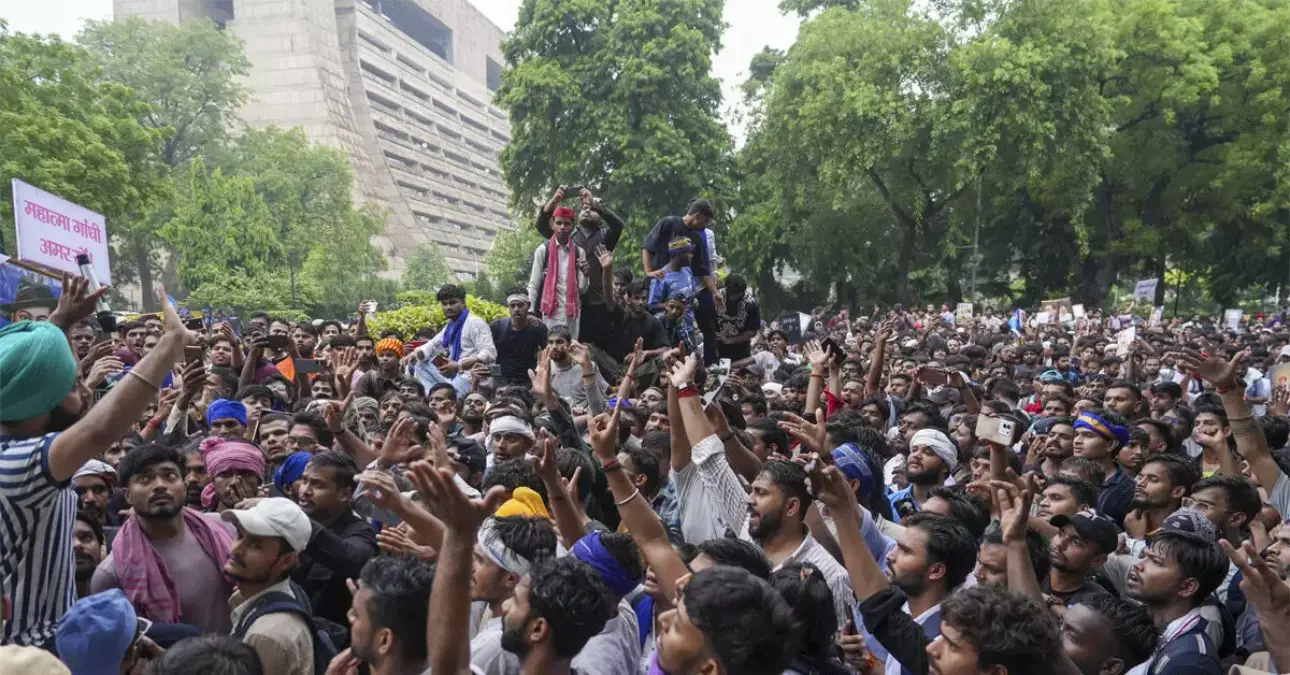
New Delhi: Union Education Minister Dharmendra Pradhan resigned July 25, ending more than a month of youth-led protests over the NEET-UG paper leak that had turned central Delhi into a permanent encampment and the Indian internet into a rolling referendum on the Modi government.
Within hours of his resignation letter reaching the prime minister, the Cockroach Janta Party, the satirical youth movement that led the agitation, announced it was calling off its protests, saying the government had accepted its demands.
The moment was without precedent. No minister in the NDA government had stepped down under sustained public pressure since Modi took office in 2014. The government had thrown nearly everything at the movement before conceding: prohibitory orders, baton charges, tear gas, pellet guns fired in the capital for the first time, an internet cut ordered on the night of the worst violence, a banned X account, and a media ecosystem that largely looked away.
None of it worked. And the reason it did not work is the story of how a generation raised on the internet dismantled the most formidable political propaganda operation in Indian politics, using the very platforms that operation was built to dominate.
A movement born from an insult
The trigger was contempt. In May, Chief Justice Surya Kant’s courtroom remark comparing India’s unemployed youth to “cockroaches” landed on a generation already reeling from the cancellation of NEET-UG 2026, scrapped on May 12 after investigators found the question paper had circulated before the May 3 exam sat by more than 2.2 million aspirants.
Abhijeet Dipke, a political communications student, posted a single question on X: what if all the cockroaches came together? Within hours he had built a website and social media pages for the Cockroach Janta Party, a satirical riff on the ruling Bharatiya Janata Party. Its membership criteria demanded applicants be unemployed, chronically online and able to “rant professionally.”
The joke metastasized. The CJP’s Instagram following crossed 25 million, more than double the BJP’s own account. When the government banned the party’s first X account citing national security, Dipke simply opened another. “Cockroaches don’t die,” he said.
Behind the satire was grief. Hindustan Times reported at least 11 NEET aspirants died by suicide in the 46 days between the exam’s cancellation and the scheduled re-test; Outlook put the figure at 13. Among them was 19-year-old Sheikh Sana, who wrote “I am sorry” on a plain sheet of paper the day before the re-test. Her mother stood at Jantar Mantar holding her daughter’s photograph as the protests swelled. Compensation for these families became one of the CJP’s three core demands, alongside Pradhan’s resignation and immunity from prosecution for protesters.
July 20: The crackdown that backfired
When tens of thousands marched toward Parliament on July 20 during the monsoon session, Delhi Police met them with baton charges and tear gas. Protesters and the CJP said about 150 students were injured and hospitalized; police countered that 118 of their own personnel were hurt and detained 70 protesters. Students faced pellet guns and batons through overnight rain and clouds of tear gas. Girls were not spared; footage showed an officer thrusting a baton into a female protester’s back.
The government ordered the internet cut. It bought a few hours, nothing more.
Because every protester was also a camera. When connectivity returned, the Indian internet became what one 18-year-old protester, Avanshika Singh, called a televised revolution: shaky smartphone footage of officers slapping and chasing unarmed students, an officer casually tripping teenagers fleeing tear gas, a mother pleading with a wall of police, alleged use of pellet guns by paramilitary forces deployed alongside police, and even officers wearing Meta smart glasses.
Niharika Soni, 19, had skipped the July 20 march. Then the videos reached her feed. “My mother and I cried for two hours, watching the videos together at home,” she said. Her mother, a longtime Modi supporter, now joined her at Jantar Mantar every day. That is what the crackdown produced: not fear, but recruitment.
Why the IT cell lost
For over a decade, the BJP’s IT cell has been the most feared instrument in Indian political communication. Modi was among the first world leaders to grasp social media’s power in 2014, and his party built an apparatus of coordinated accounts and friendly creators that could set the national agenda by breakfast, and dox, troll and delegitimize critics by lunch. The Congress never caught up. Regional parties copied it poorly. For 12 years, the Indian internet had a home team.
So why did that machine collapse against a crowd of teenagers? Five reasons stand out.
The playbook was built for opponents, not children. The IT cell’s core weapons are delegitimization and fear: brand the critic anti-national, dig up their affiliations, make an example of them. That works on politicians, journalists and activists with careers and reputations to destroy. It does not work on an 18-year-old NEET aspirant filming tear gas with her eyes streaming, or on a mother holding a photo of her dead daughter. Every attack on the protesters read, instantly and virally, as the state bullying grieving students. When pro-government handles pushed the line that the protesters were political provocateurs rather than genuine students, the students answered with hospital wristbands and stitches.
Self-mockery is troll-proof. Cultural critic Anurag Minus Verma, author of “The Great Indian Brain Rot,” identified the movement’s central innovation: the protesters had already ridiculed themselves. They were cockroaches by their own declaration. The IT cell’s standard move of splitting a protest into castes, regions and ideologies found no seam to attack; “cockroach” had become a single, absurd, unified identity. You cannot meaningfully insult people whose entire brand is an insult they stole from a judge. Verma argued that in a post-ironic internet, anything said with irony travels faster, and the government’s earnest, chest-thumping messaging simply could not keep pace with it.
Speed and volume favored the kids. The IT cell runs on coordination: talking points go out, hashtags trend on schedule. Gen Z needed no coordination. Millions of accounts produced memes, edits and rap tracks organically, faster than any war room could respond. Protesters recreated formats from the Nepal, Bangladesh and Hong Kong uprisings, remixed them with One Piece flags and Avengers costumes, and set police footage to hip-hop. As 20-year-old Ipshita Gulyari put it at Jantar Mantar: “We were using Instagram before I could read a clock.” Modi, she said, had messed with the wrong generation.
The counter-narrative had no oxygen. Pro-government outlets and handles did try. RSS-linked publications framed the protests as mob rule engineered by “anti-national” elements and “agent provocateurs,” and demanded probes into a broader conspiracy. The framing found no purchase outside the converted, because the raw footage contradicted it in real time, and because young Indians had already migrated away from government-friendly television toward independent digital outlets and their own feeds. Meanwhile, the BJP’s own posts were buried under thousands of replies demanding the minister resign. The party’s comment sections became CJP territory.
Fear had switched sides. The IT cell’s ultimate product was always fear: of being doxed, of being labeled, of being jailed. By late July, protesters were mocking Modi by name, on camera, in front of police lines, something almost unthinkable in Delhi a year earlier. “Hating Modi is cool on the internet now, after years of criminalising dissent,” Singh said. Once the fear broke, the machine had nothing left to sell.
The clearest sign of the reversal came from the top. On July 23, Modi made his first comments on the protests, posting on X that “nothing is more important than the welfare and future of our youth.” Dipke’s reply was a meme within minutes: Pradhan’s photograph captioned, “Hi, my name is Nothing.” The prime minister had posted; a graduate student had won the exchange.
What the resignation means
Announcing his exit, Pradhan wrote that he deeply respected “the aspirations, feelings, and legitimate expectations of the country’s youth.” BJP president Nitin Nabin insisted the resignation reflected “the highest standards of integrity,” a face-saving line that convinced almost no one at Jantar Mantar, where celebrations ran through the night.
Dipke welcomed the resignation while cautioning that the work was unfinished. The deeper demands remain open: an overhaul of the National Testing Agency, whose exams have now been compromised in both 2024 and 2026; compensation for the families of aspirants who died by suicide; and structural reform of an examination economy in which, investigators found in both leak scandals, question papers were sold for lakhs of rupees to those who could pay.
The political lesson, though, is already written. A propaganda apparatus built over 12 years, funded lavishly and feared universally, was beaten in roughly 10 weeks by unemployed, chronically online young people armed with phones, grief and jokes. Analysts note that the demand for accountability did not stop at the education minister; for the first time, it reached the prime minister himself, chanted openly on the streets of the capital.
The IT cell was designed to win arguments. Gen Z declined to argue. They laughed, they filmed, and they refused to be afraid. Against that, the machine had no answer.