
There is a peculiar law of physics that exists only in India call it the First Law of Bureaucratic Combustion. It states that the probability of a government office catching fire is directly proportional to how close an investigation is to actually finding something. Forget Newton. This is the only law that consistently holds in Lutyens’ Delhi, Kolkata’s Alipore, and everywhere in between.
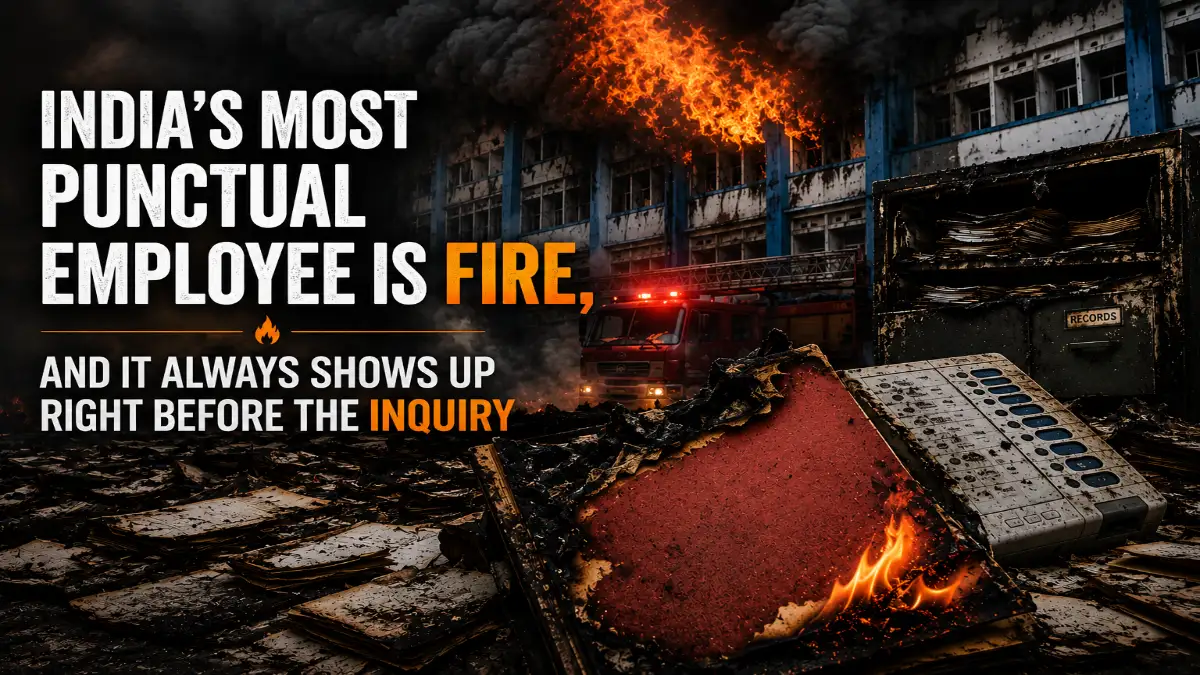
The latest entry in this glorious tradition comes from Kolkata, where a fire tore through the New Administrative Building — housing the South 24 Parganas Zilla Parishad — in Alipore on June 10, destroying around 4,000 EVMs that had been used in the recent West Bengal Assembly elections. What makes this fire special — and by special, we mean “deeply suspicious in the way that only Indian government fires manage to be” — is its sense of geography. The blaze started on the lower floors, was brought under control, and then, almost as an encore, a second fire mysteriously erupted hours later on the upper floors where the election department’s strongroom was located. The floors in between, housing the Sarva Shiksha Mission, Mid-Day Meal and Horticulture departments, escaped largely unscathed. Untouched. Pristine. As if the fire had a floor plan and a grudge.
State Fire Services Minister Koushik Chowdhury himself said this did not look like a “normal fire,” which is possibly the most Indian sentence ever uttered by a minister — an admission that something is wrong, paired with a promise to wait for the forensic report before saying anything more. Police have registered an FIR and formed a Special Investigation Team to determine whether this was an accident or “foul play.” Naturally. Because nothing says “rigorous probe” like investigating a fire that conveniently happened to the only floor anyone cared about, in a building where the main electrical grid had reportedly already been cut off after the first blaze.
The EVMs in question were not just any machines lying around in storage — they belonged to roughly 10 to 15 Assembly constituencies, including high-profile ones like Kasba, Jadavpur, Behala East, Behala West, Metiabruz and Satgachia, from the West Bengal Assembly election whose results came out on May 4. Under Election Commission rules, these machines are required to be kept sealed for 45 days after results are declared, precisely so they remain available if any result is legally challenged. The fire arrived comfortably within that window.
The ruling TMC, which lost power in the state to the BJP in this very election, was quick to call the fire’s pattern “highly suspicious” and to suggest a deliberate attempt to destroy election evidence. The BJP, now in government, has pointed to administrative failure and ageing infrastructure. Congress leader Pawan Khera asked the Election Commission to clarify whether these were indeed the EVMs used in the recent polls, and pointedly noted that India seems to specialise in the kind of “convenient” fire that, in Bollywood films, always arrives just in time to destroy the one piece of evidence everyone was waiting for.
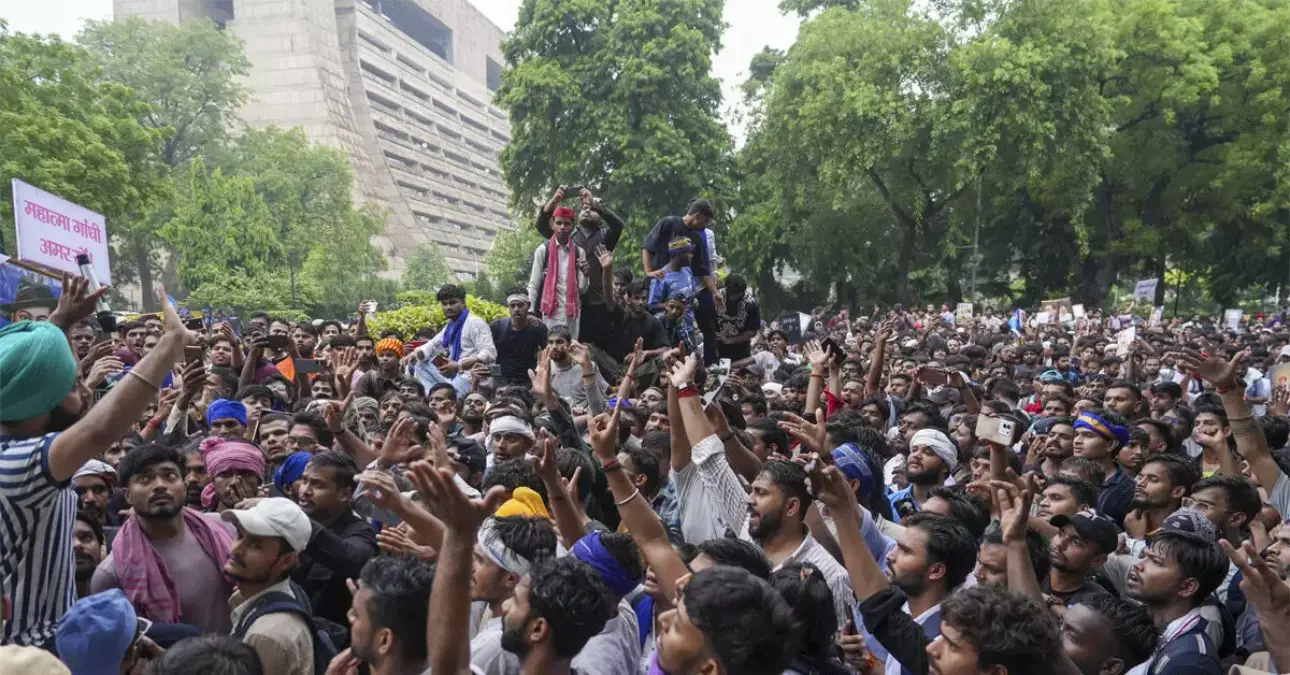
Now, travel about 1,500 kilometres northwest, to Delhi’s ITO area, where another fire broke out in early June — this one amid the ongoing storm over the CBSE On-Screen Marking controversy and the NEET-UG paper leak saga. Initial reports said the blaze had hit the Ministry of Education’s office. Opposition leaders, who by now have a Pavlovian response to the words “ministry” and “fire” appearing in the same sentence, immediately called it “very fishy” and demanded answers. The Ministry later clarified that the fire actually broke out at the School of Planning and Architecture, a separate institution on the same campus complex, and not at its own office on Dr Rajendra Prasad Road.
Fair enough — that correction matters, and credit where due, the record got set straight quickly this time. But here’s the thing: the fact that an entire political class, across party lines, instantly assumed “fire near education ministry, during exam scandal, must be evidence destruction” tells you everything about the country’s collective muscle memory. Nobody had to explain the joke. Everybody got it immediately.
Why does this keep happening? Or rather — why does everyone believe it keeps happening, whether or not each individual fire is actually arson?
Part of the answer is structural. India’s government buildings are old, overloaded with wiring that was designed for a fraction of today’s electrical load, often missing functional fire exits, and routinely failing basic safety audits that exist mostly on paper. Add to that the fact that these buildings are also warehouses for paper records, server racks, and now apparently strongrooms full of EVMs, and you have a tinderbox dressed up as an administrative headquarters. Short circuits are common. Genuinely common. Most fires probably are just fires.
But “probably” is doing a lot of work in that sentence, and that’s the real problem. Decades of cases where crucial evidence — files, ledgers, hard drives, now EVMs — has gone up in flames at suspiciously convenient moments have created a credibility deficit so deep that even a real accident gets read as a cover-up. When the Kolkata fire skips four floors and lands precisely on the strongroom, after the power was cut, you don’t need a conspiracy theory factory to start asking questions. The building did the conspiracy theory’s job for you.
And that’s really the punchline here. It doesn’t matter whether this particular fire was sabotage or just spectacularly bad luck with old wiring. What matters is that nobody — not the opposition, not ordinary citizens, not even, one suspects, some people within the government — is willing to give the “accident” theory the benefit of the doubt anymore. That’s not a problem with the public’s imagination. That’s a problem with the institutions’ track record.
Until government buildings get audited like they actually matter, and until “the relevant files were destroyed in a fire” stops being an acceptable answer to a parliamentary question, India’s offices will keep catching fire at the worst possible moments — and everyone will keep nodding along, because by now, we all know the drill.
(The author is a journalist covering politics, education, and public affairs for The Jan Post.)