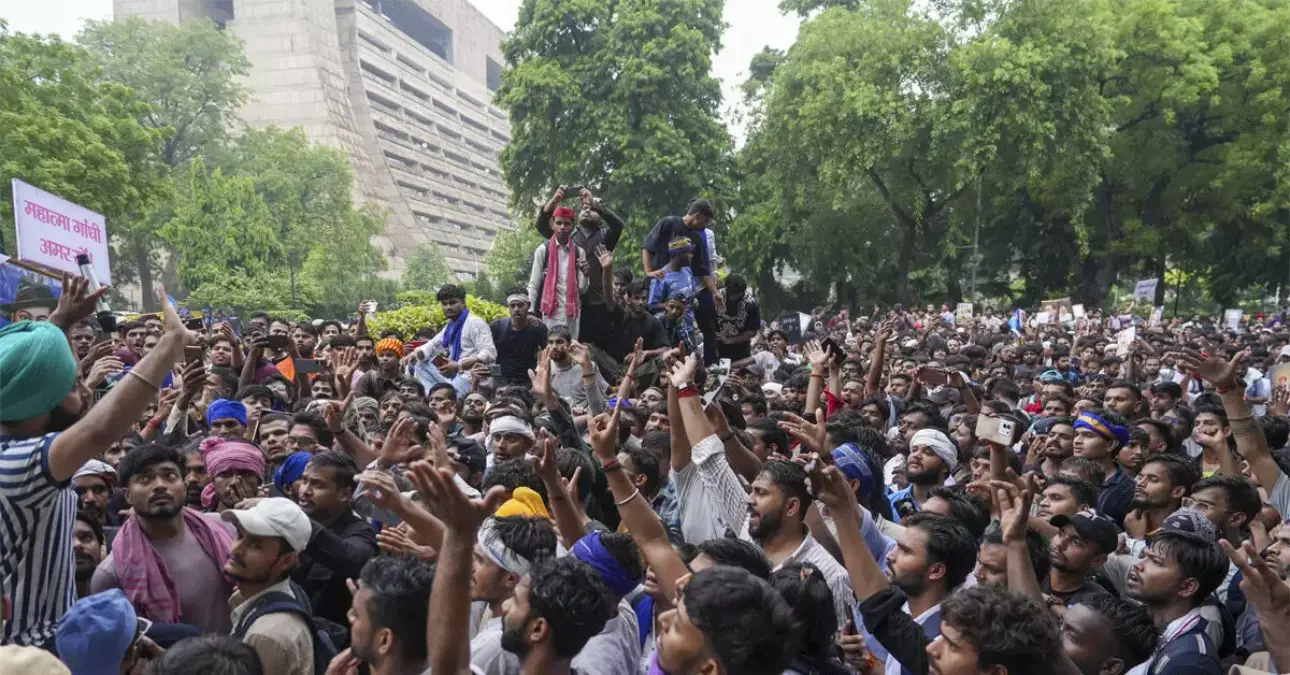

A few days ago, the Chief Justice of India, Surya Kant, made an offhand remark during an open court hearing. Referring to unemployed young people, he said: “There are youngsters like cockroaches, they don’t get any employment, they don’t have any place in a profession.” Within days, a satirical political entity called the Cockroach Janta Party, a deliberate parody of the ruling Bharatiya Janata Party, had amassed over 22 million Instagram followers. It overtook the BJP and the Indian National Congress, India’s two largest political parties, in social media reach in less than a week.
The Cockroach Janta Party is not a registered political outfit. It has no candidates, no booths, no banners on village walls. Yet it has a manifesto, a logo, and a voice, one that speaks directly to a generation raised on reels and fed on rage. Its mock manifesto calls for cancelling the broadcast licences of media houses owned by business tycoons close to the government and positions itself as the self-declared “Voice of the Lazy & Unemployed.” Several mainstream opposition politicians, including Samajwadi Party chief Akhilesh Yadav and Trinamool Congress MP Mahua Moitra, have endorsed it.
The episode is absurd, irreverent, and entirely on-brand for Gen Z, and it tells us something profound about the fault lines running beneath Indian democracy today.
A Generation Unlike Any Before It
India’s Gen Z, those born between 1997 and 2012, numbers more than 370 million people, nearly a quarter of the country’s 1.5 billion population. They are the most digitally connected generation in Indian history, growing up with data plans, affordable smartphones, and social media feeds that shape their political minds.
By the time of the 2024 Lok Sabha elections, India had over 750 million active internet users (This number has gone up to 958 million). Of these, around 362 million used Instagram, approximately 467 million were active on YouTube, and over 535 million used WhatsApp.
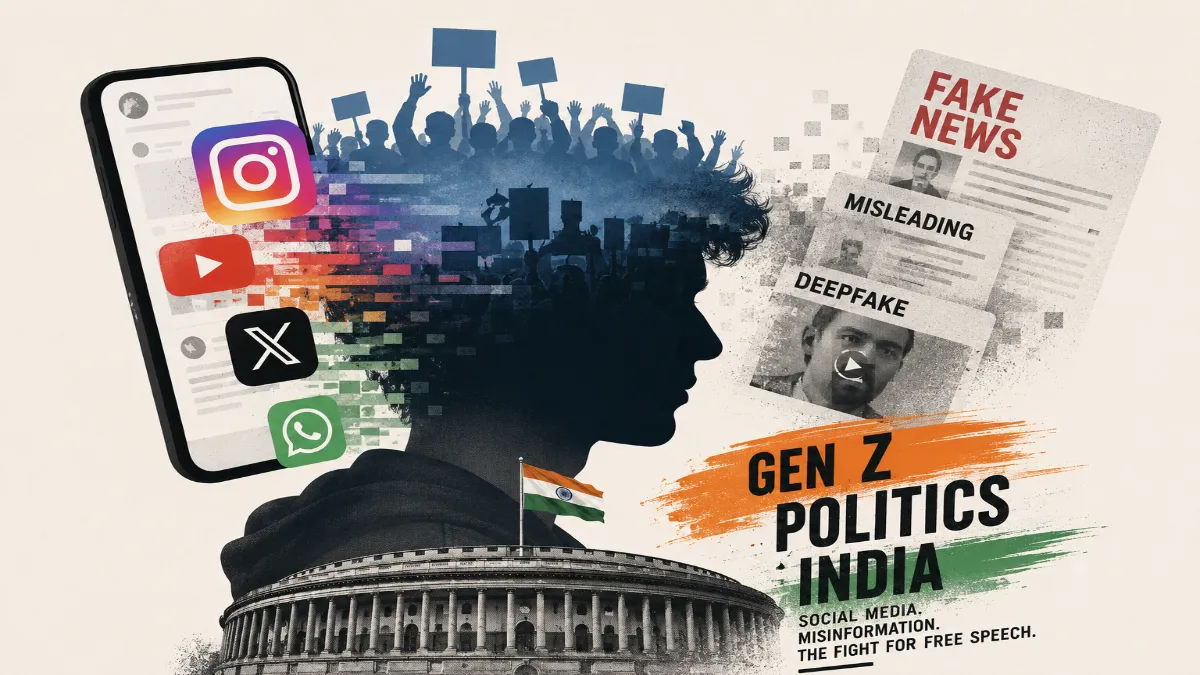
Gen Z are the core of these numbers. For this generation, the TV debate panel and the newspaper editorial page are largely irrelevant. Their political education happens on Instagram Reels, YouTube Shorts, and encrypted WhatsApp forwards, a media environment that is simultaneously more personalised and more manipulable than anything that came before it.
What makes Indian Gen Z distinct, however, is a profound ambivalence. They are hyper-connected but not always hyper-engaged in formal politics.
Only 38% of 18-year-olds registered as voters for the 2024 general elections. The Election Commission of India has repeatedly identified “youth apathy” as a structural concern, to the point that it launched dedicated campaigns like Turning 18 and You Are the One to coax first-time voters to the polls.
Yet the same generation that stays home on polling day will spend hours consuming and sharing political content online.
Understanding this paradox, digital engagement without electoral engagement, is the key to understanding Gen Z’s relationship with Indian politics.
How Gen Z Consumes Political Content
Ask a 20-year-old in Patna, Bengaluru, or Lucknow where they get their political news, and the answer is almost never a newspaper or TV channel. It is more likely a YouTube shorts, an Instagram reel, or on X (formerly Twitter).
India’s legacy news media, dominated by channels that critics accuse of being aligned with the ruling establishment, have lost credibility with large sections of young viewers. In its place, a vibrant ecosystem of independent YouTube news channels has emerged.
Some, like Ravish Kumar or Dhruv Rathee, command audiences of tens of millions across languages and have become primary sources of political analysis for young Indians. Others function at a local level, reporting on state politics in regional languages with a frankness that national broadcasters have forgotten.
According to the Reuters 2025 Digital News Report, young Indians increasingly turn to influencers and AI-powered tools for news, reshaping consumption habits in ways that traditional outlets have struggled to respond to. Instagram and YouTube are the preferred platforms; WhatsApp is viewed with more scepticism by younger users who are aware, if not always wary, of its misinformation problems.
Short-form video is the dominant format. Political parties understood this early. During the 2024 Lok Sabha elections, both the BJP and the Congress deployed social media teams to create Reels, Shorts, and meme content explicitly designed to attract younger voters.
They adopted Gen Z slang, trending audio, and humour-driven formats. The Congress party’s digital makeover of Rahul Gandhi, shifting his image from entitled dynast to grassroots traveller through the Bharat Jodo Yatra, was as much a social media campaign as it was a political one. BJP countered with its own ecosystem of content, hashtags, and influencer partnerships.
Political parties no longer control the narrative the way they once did. Gen Z audiences are producers and remixers of political content, not just consumers.
A speech clip gets memed. A minister’s gaffe becomes a reel. A judicial remark becomes a 22-million-strong satirical party.
The pace and creativity of this content ecosystem have fundamentally altered the speed at which political reputations are built and destroyed.
Influencers and the New Political Mobilisation
If television once made politicians into celebrities, social media has begun making celebrities into political actors and blurred the line between the two.
Political parties in India have moved decisively away from traditional celebrity endorsements, actors, and cricketers toward a new class of digital influencers who are more cost-effective, more targeted, and far more trusted by their audiences.
Influencers on YouTube and Instagram are engaged to post content that is hyperlocal and micro-targeted, designed to reach specific demographics, rural voters, young women, first-generation internet users in smaller cities, in ways that mass media cannot.
These influencers publish both direct and subliminal political messaging, often without disclosing compensation or party affiliation. Their audiences, who follow them for entertainment or lifestyle content, receive political messaging wrapped in the language of authenticity.
The Heinrich Böll Stiftung, in its 2024 analysis of the Indian elections, noted that this practice circumvents Election Commission regulations on political advertising, since undisclosed paid content does not register as a political ad.
The Cockroach Janta Party illustrates a different version of this dynamic, the organic political influencer. Its founder, Abhijeet Dipke, is a 30-year-old political communications graduate and former Aam Aadmi Party worker. His satirical account did not begin with party funding or strategic deployment. It began with a meme, spread through shares, and crystallised into a movement. Politicians from opposition parties quickly aligned themselves with it, recognising its reach. This is the new grammar of political mobilisation in India: movements that begin organically on social media and force formal politics to respond.
The Bihar elections of 2025 showed a similar pattern. Prashant Kishor’s Jan Suraj movement used social media heavily to mobilise young voters who had grown deeply cynical of traditional political parties, a generation that, according to the Association for Democratic Reforms, saw 68% of sitting legislators facing criminal cases. The youth vote in Bihar was not just about party loyalty; it was about accountability, and social media was the arena in which those demands were articulated.
Misinformation and the Echo Chamber
The same platforms that empower Gen Z to speak also expose them to a systematic deluge of misinformation, and India is particularly vulnerable.
The World Economic Forum’s Global Risks Report 2024 identified India as one of the most misinformation-prone nations on earth. The mechanisms are well-documented. WhatsApp’s large group chats, many with hundreds of members, serve as distribution networks for unverified content that spreads at speed across languages and communities.
Research on the 2019 elections showed that misinformation campaigns were run by major parties as tools against their opponents, covering topics from corruption and religion to gender and national security. The same cross-platform machinery operated during 2024, now turbocharged by AI.
Deepfakes have become a new frontier. During state elections in Rajasthan, Madhya Pradesh, and Telangana in 2023, documented deepfake videos of political figures were circulated on WhatsApp and social media. By the 2024 Lok Sabha election, their use had become widespread. An AI startup called The Indian Deepfaker was found to have offered services cloning politicians’ voices to create personalised campaign messages, raising acute questions about the line between digital campaigning and fabrication [As reported by The Conversation].
WhatsApp’s encrypted, private-group format creates what analysts have called a structural accountability gap: the government cannot monitor content at scale, and platforms cannot enforce moderation in private chats.
The result is an information ecosystem where the same piece of misinformation can be translated into fifteen Indian languages and spread simultaneously across urban and rural communities, far outpacing any fact-checking response.
For Gen Z, the consequences are complicated. Many are aware of misinformation as a phenomenon; fewer are capable of identifying it in real time. Fact-checking outlet BoomLive has described what it calls an “online battle” within the generation itself, one side viewing youth-led online movements as legitimate democratic expression, the other suspecting foreign manipulation or partisan orchestration behind viral content.
The Free Speech Battleground
If misinformation is the poison in India’s digital bloodstream, censorship is the antidote that the state (Political) has discovered, and Gen Z is caught in the middle of both.
Freedom of speech and expression is guaranteed under Article 19(1)(a) of the Indian Constitution. But the state is empowered to impose “reasonable restrictions” under Article 19(2), citing sovereignty, security, public order, decency, or morality, and successive governments have used this provision frequently in the digital age. The result is a constitutional tension that plays out daily on the very platforms where Gen Z forms its political identity.
The legal architecture shaping online speech in India is formidable. Section 69A of the Information Technology Act grants the government authority to block public access to online content in the interest of national security or public order, without being required to notify the user or the owner of the blocked content about the reason.
In the landmark 2015 case Shreya Singhal v. Union of India, the Supreme Court struck down Section 66A of the IT Act for having a “chilling effect” on free speech. But the broader regulatory machinery has only grown more elaborate since then.
The IT Rules of 2021, and subsequent amendments, have expanded government control over digital content in ways that have drawn sharp criticism from civil liberties groups, journalists, and even the United Nations. UN Special Rapporteurs wrote to the Indian government expressing serious concern that the new rules might compromise the privacy and free speech rights of internet users.
In October 2025, the central government formalised the Sahyog portal, a centralised platform allowing thousands of officials, including district-level police, to issue content takedown notices directly to tech companies with little transparency and fewer safeguards than a court order would require.
Human Rights Watch, in an April 2026 report, documented an exponential increase in content restricted on Instagram and Facebook in India in response to government orders. Among the content ordered blocked were posts that constituted satire, criticism of government policy, and content from opposition politicians.
X (formerly Twitter) has suspended several accounts primarily for posting content critical of the BJP or Prime Minister Modi. The government, notably, issues blocking orders in secret, leaving users without knowledge of why their posts disappeared or any formal mechanism to contest the decision.
This opacity matters enormously to Gen Z, for whom social media is not a supplementary channel of expression but the primary one. When a meme account is suspended, a satirical creator’s video is taken down, or an independent news YouTube channel is blocked without explanation, it lands differently for a generation that has no parallel relationship with print or broadcast media.
Their political voice, their community, their sense of civic identity, all of it lives on these platforms. Censorship, for them, is not an abstract policy debate; it is a felt experience.
Internet shutdowns are another instrument that has fallen heavily on young Indians.
There were 84 internet shutdowns across India in 2024 and at least 40 in the first half of 2025. Human Rights Watch has described such shutdowns as undermining free expression and functioning as “collective punishment” that disproportionately harms marginalised communities.
During the 2024 farmers’ protests, internet services were suspended across multiple districts in Haryana. During periods of communal tension, digital blackouts have become routine. For Gen Z, accustomed to being permanently online, a shutdown is a civic event: a moment when the state visibly asserts control over the means of communication.
The irony is that censorship, far from silencing Gen Z, has often radicalised it. The Cockroach Janta Party’s manifesto explicitly includes media reform, calling for the cancellation of licences for channels seen as government-aligned. The movement’s very existence is a response to the perception that mainstream media has been captured, and that social media is the only remaining free space.
In India, as in Nepal, where the government’s attempted ban on social media platforms in September 2025 triggered the youth uprising that toppled the prime minister, restricting digital expression for Gen Z tends to produce anger and frustration.
The judicial landscape, too, is contested. Comedian-activist Kunal Kamra’s legal challenge to the government’s fact-checking amendments to the IT Rules, arguing they were unconstitutional and exceeded the Act’s authority, resulted in a split verdict at the Bombay High Court, with a tie-breaking judge ruling in favour of the petitioners. The case has since gone on appeal to the Supreme Court, leaving the regulatory framework in a state of legal uncertainty even as the government continues to issue takedown notices and expand the Sahyog portal’s reach.
The Ballot Box and Beyond
The central puzzle of Gen Z’s political engagement in India is the gap between online activity and offline participation. Young Indians who share political content daily, who follow election results obsessively, and who flood Instagram with commentary are also among the least likely to register to vote or turn up at a booth.
This is partly structural. Registration processes remain cumbersome in many states. Many young people migrate to cities for education or work, complicating their ability to vote in their home constituencies. The sense that individual votes change little, especially in constituencies dominated by established political machines, contributes to a learned helplessness that social media activism can substitute for, rather than supplement.
The 2025 Bihar elections saw unprecedented attention on the youth vote as a distinct and mobilisable bloc. Gen Z voters in Bihar, facing a state with a 13.3% urbanisation rate, limited industrial growth, and acute unemployment, were demanding not the patronage politics of the past but structural change: jobs, education, and dignity. Their demands were shaped and amplified by social media, creating pressure on candidates that would have been harder to sustain in a pre-digital era.
Online voter registration drives, youth-led political podcasts, and social media fact-checking communities are building, piece by piece, a more politically literate young citizenry. The Election Commission’s #YouthVoteMatters initiative and its collaboration with influencers through the SVEEP programme represent institutional acknowledgement that reaching Gen Z requires meeting them on their own platforms.
India’s Gen Z is also watching its neighbours with close attention.
In Bangladesh in 2024, a student-led uprising helped topple the government of Sheikh Hasina. In Nepal in 2025, youth-led protests, sparked in part by a government ban on social media platforms, brought down Prime Minister KP Sharma Oli in 48 hours.
Both movements relied heavily on social media for coordination and amplification. Indian Gen Z observers have noted both the inspiration and the difference: India’s fragmentation, regional, linguistic, caste-based, and religious, makes a unified national youth movement far harder to assemble.
India’s Gen Z is Loud Online, But Missing From the Ballot Box
One of the biggest contradictions in Indian democracy today is that the country’s youngest generation is extremely active politically on social media, yet a large number of them are still missing from the electoral system.
According to Election Commission of India (ECI) data before the 2024 Lok Sabha elections, less than 40% of eligible first-time voters aged 18–19 had registered to vote.
India has nearly 49 million people in this age group. However, only around 18 million of them were registered on the electoral rolls.
Youth Voter Registration in India (2024)
| Category | Data |
|---|---|
| Estimated 18–19 population | ~49 million |
| Registered young voters | ~18 million |
| National enrollment rate | ~38% |
| Unregistered eligible youth | ~31 million |
This means nearly 62% of eligible first-time voters were still outside the voting system.
The numbers reveal an important reality about modern Indian youth politics:
Young Indians are politically expressive, but not always electorally active.
Today’s Gen Z:
- Watches political reels daily
- Shares memes constantly
- Follows political influencers
- Debates government policies online
But many still do not vote.
This gap between online political engagement and actual voting explains why social media movements like the Cockroach Janta Party became so popular among young Indians.
For many young citizens, Instagram, YouTube, and meme culture have become alternative political spaces where they can express anger, frustration, and satire freely.
Bihar, Delhi and UP Show Serious Youth Disengagement
The Election Commission data becomes even more striking when state-wise numbers are examined.
Some states performed relatively well in registering young voters. Telangana emerged as one of the strongest examples, with nearly 66.7% enrollment among eligible 18–19-year-olds. Jammu & Kashmir and Himachal Pradesh also crossed 60%.
However, large states like Bihar, Uttar Pradesh, and Delhi showed extremely poor youth enrollment rates.
State-Wise Youth Enrollment Rates (2024)
| State | Enrollment Rate |
| Telangana | 66.7% |
| Jammu & Kashmir | Above 60% |
| Himachal Pradesh | Above 60% |
| Maharashtra | 27% |
| Uttar Pradesh | 23% |
| Delhi | 21% |
| Bihar | 17% |
Bihar’s numbers were especially alarming.
Out of approximately 5.4 million eligible young voters in Bihar, only around 930,000 were enrolled.
That means nearly 83% of eligible first-time voters in Bihar were not registered to vote.
This reflects deeper structural problems:
- High unemployment
- Migration
- Weak institutional trust
- Political frustration among youth
Many young people increasingly feel disconnected from traditional political systems.
As a result, they often turn toward:
- Political satire
- Meme pages
- YouTube commentary
- Instagram activism
- Influencer-led political discussions
This is one reason why freedom of speech and online expression have become so important for Gen Z.
The Pattern Was Visible Even in 2019
The youth voter problem is not new.
Even during the 2019 Lok Sabha elections, the Election Commission data showed that young voter participation was very weak.
At that time:
- India had around 4.85 crore people in the 18–19 age group.
- Only around 1.43 crore were registered voters.
Youth Enrollment Data (2019)
| Category | Data |
| Estimated 18–19 population | 4.85 crore |
| Registered voters | 1.43 crore |
| Enrollment rate | 29.49% |
| Missing eligible voters | 70.51% |
This means more than 70% of eligible first-time voters were absent from the voter rolls.
The data clearly shows that India’s youth participation crisis is structural, not temporary.
The Politics of Virality
The Cockroach Janta Party will likely not become a registered political party. Its satirical manifesto will not become policy. But it has done something significant: it has revealed the speed and scale at which Indian Gen Z can mobilise around a shared grievance, and it has embarrassed institutions whose authority rests on being taken seriously.
This is the new political power of Gen Z in India, not yet the power to govern, but the power to puncture. Through memes, reels, and satirical movements, young Indians are holding a mirror to the political class in ways that formal opposition often cannot.
They are demanding accountability in real time, forcing leaders to reckon with how they appear not just to newspaper editors but to 22 million Instagram followers.
The challenge for Indian democracy is to channel this energy, irreverent, restless, and chronically online, into durable civic participation. That means making registration easier, making first-time voting meaningful, and making political institutions legible to a generation that has grown up trusting creators over institutions.
For now, the cockroach has become a symbol. And in the strange, recursive logic of social media politics, that may be exactly the point.