
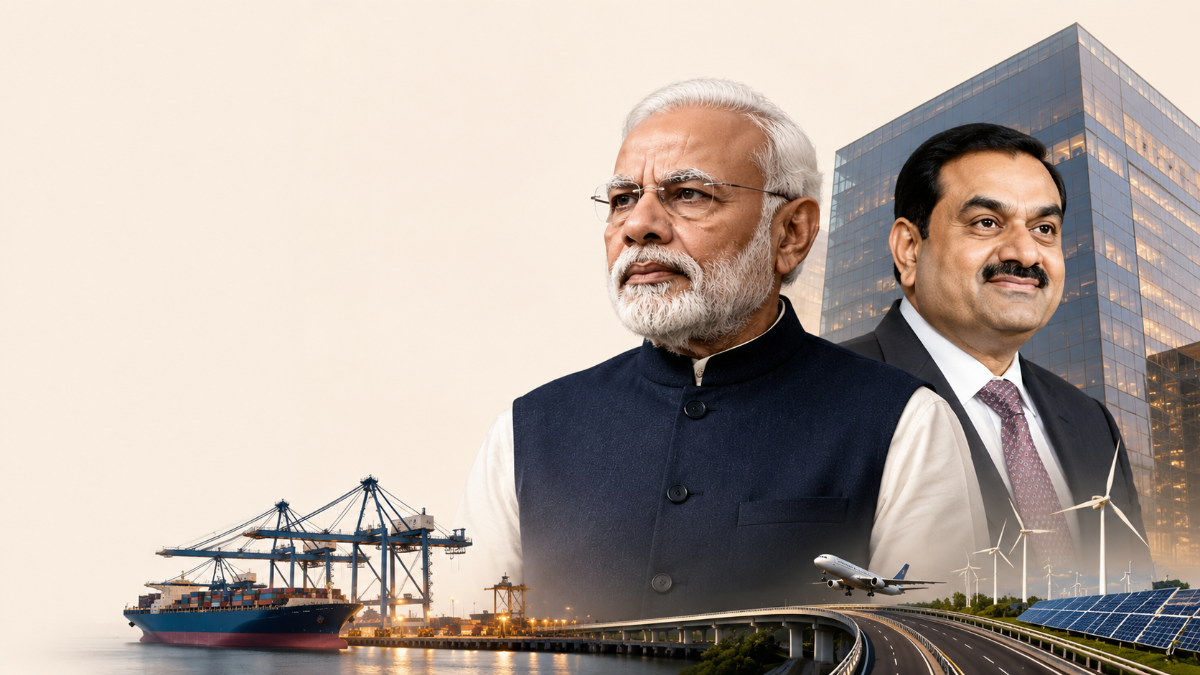
Between 2002 and 2026, Gautam Adani rose from a regional port operator in Gujarat into one of the world’s wealthiest men, becoming a leader across ports, airports, power, renewable energy, defence, roads, media, data centre service and cement sectors. This astronomical rise coincided with the political rise of Narendra Modi, first as Chief Minister of Gujarat (2001-14) and then as Prime Minister of India (2014-till now).
This article traces the chronological development of their relationship and examines six categories of evidence: early political alliance, policy design, airport privatisation, infrastructure contracts, public institutional capital, and diplomatic facilitation, to assess whether the Adani Group’s rise reflects extraordinary enterprise or extraordinary access to state power.
All claims are sourced from regulatory filings, court records, investigative journalism, and official government documents.
The Foundation of Modi-Adani Nexus (1988–2001)
Gautam Adani founded his commodities trading company in Ahmedabad in 1988. By 1994, Adani Enterprises was publicly listed. By 1998, he had acquired his first ship docks at Mundra Port in Gujarat. By 2000, Mundra had become India’s largest private port, and Adani Enterprises had become the country’s largest private sector trading house, with a turnover of ₹3,300 crore.
His expansion into coal trading in 1999 and urban gas distribution in 2001 further extended his footprint. By this point, Adani was a significant Gujarati businessman, but still primarily a regional figure.
Narendra Modi became Chief Minister of Gujarat in October 2001, following a sudden change in leadership within the BJP. He arrived in office as a relative unknown outside Gujarat.
Within months of Modi’s appointment, two events would set the course for everything that followed.
In February-March 2002, Gujarat descended into communal violence following the Godhra train burning. Over 1,000 people, the majority of them Muslim, were killed in what became the worst communal pogrom in independent India’s post-1984 history. Modi’s handling of the crisis drew sustained national and international condemnation.
The United States revoked his visa. The UK Foreign Office expressed concern. The Confederation of Indian Industry (CII), India’s most powerful trade body, threatened to disinvest from Gujarat.
This is the moment that Adani chose.
Rather than distancing himself, Adani became one of the lead figures in a counter-offensive against the CII’s criticism. He helped establish the Resurgent Group of Gujarat, a parallel business body designed specifically to dilute CII’s influence and signal continued corporate confidence in Modi’s Gujarat.
| The Resurgent Group of Gujarat was a powerful coalition of local industrialists formed in 2002 to back then-Chief Minister Narendra Modi. It was established by business leaders, notably Gautam Adani, as a rival business council after the Confederation of Indian Industry (CII) criticised the state government’s handling of the 2002 Gujarat riots. |
He was a founding member and principal promoter of the Vibrant Gujarat summit, a biennial mega-event that brought national and international business leaders to Gujarat to invest in the state, and which became Modi’s single most powerful instrument for projecting himself as a development-oriented leader on the national stage.
The relationship was constitutive. Adani gave Modi political legitimacy at the moment of his deepest vulnerability. Modi gave Adani an operating environment of extraordinary permissiveness.
Between July 2002, when Adani Enterprises’ share price stood at ₹1.22 , and May 2014, when Modi swept to national power, the stock rose to ₹69.75. That is a gain of over 5,700 percent over twelve years. The group’s revenue grew from $765 million in 2002 to $8.8 billion by March 2014.
British journalist James Crabtree, who wrote a book on India’s new billionaires, described the two men as having “symbiotic careers.” He told the BBC: “Mr Modi’s pro-business policies helped Mr Adani expand.”
Modi-Adani Nexus at the National Stage (2014)
On May 16, 2014, the Bharatiya Janata Party won the Lok Sabha election with a historic majority of 282 seats, the first outright majority by a single party since 1984. Narendra Modi was to be sworn in as Prime Minister.
The aircraft that carried Modi from Ahmedabad to New Delhi for his swearing-in prominently displayed the logo of the Adani Group.
In the weeks after the election, Adani attended Modi’s private functions, including the wedding of Modi’s political associates. Modi reciprocated attendance at Adani family events, including the marriage of Adani’s son in Goa.
Policy Design (2015–2018)
Once in national power, the Modi government began designing several major infrastructure initiatives that would, over the following decade, prove enormously advantageous to the Adani Group. Three are central to any rigorous analysis.
1. The Sagarmala Programme (March 2015)
On March 25, 2015, the Union Cabinet chaired by Prime Minister Modi approved the ambitious Sagarmala Programme, a comprehensive national initiative for port-led development. Its stated aims were rational and publicly beneficial: modernise India’s ports, build coastal road and rail connectivity, develop coastal economic zones, and reduce logistics costs.
The programme was well-conceived. India’s 7,500-kilometre coastline had long been underutilised as an economic asset. But examine who was positioned to benefit most from the programme’s implementation.
By 2015, the Adani Group through Adani Ports and Special Economic Zone (APSEZ) was already the dominant private port operator in India. Its Mundra Port in Gujarat handled the largest volume of any private port. It had additional terminals in Andhra Pradesh, Odisha, and beyond.
The Sagarmala framework committed the state to investing in the very connectivity infrastructure, road networks, rail linkages, coastal shipping lanes, economic zone designations, that directly increased the commercial value and traffic volumes of Adani’s existing private terminal assets.
Every rupee spent by the state improving the road to Mundra increased the attractiveness of Mundra. The public paid.
By FY 202-25, APSEZ handled 27 percent of all cargo moving through India’s ports, and 45.5 percent of all container cargo.
In March 2026, Prime Minister Modi personally inaugurated APSEZ’s new terminal at Haldia, West Bengal. The company’s own press release described the event as “a direct expression of India’s Sagarmala programme and the PM Gati Shakti National Master Plan.” The head of government was inaugurating a private corporation’s facility as a fulfilment of national policy.
2. The Dedicated Freight Corridor (Accelerated Post-2014)
The Dedicated Freight Corridor (DFC), a network of exclusive railway tracks for goods movement, had been planned and partially funded under the previous UPA government. After 2014, its implementation was dramatically accelerated. Modi was fond of pointing out publicly that “not a single kilometre of track was laid before 2014”.
The DFC’s impact on Adani’s logistics empire is structural: every tonne of cargo that moves faster and more cheaply by rail from industrial clusters to ports increases the competitive advantage of the company that operates the dominant ports at those corridors’ endpoints.
The freight corridor makes Mundra more valuable. It makes Adani’s multi-modal logistics parks, positioned at nodes along the corridor, more attractive to industry.
3. Renewable Energy Ambition and the Solar Contracts (2015–2020)
The Modi government set ambitious renewable energy targets, 175 GW of clean energy by 2022, revised upward to 500 GW of non-fossil fuel capacity by 2030. Central to achieving these targets was a programme in which the Solar Energy Corporation of India (SECI), a government entity, signed large-scale power purchase agreements with private renewable energy producers, who would then supply electricity to state electricity distribution companies (DISCOMs).
Adani Green Energy became one of the largest beneficiaries of these contracts. The group’s crown jewel is the Khavda Renewable Energy Park in western Gujarat, planned to be one of the largest renewable energy projects in the world, producing 50 gigawatts on completion.
The significance of these contracts only becomes clear in hindsight. In November 2024, a United States federal grand jury in Brooklyn unsealed a five-count criminal indictment against Gautam Adani, his nephew Sagar Adani, and six others.
The indictment alleged that between 2020 and 2024, the defendants “agreed to pay more than $250 million in bribes to Indian government officials to obtain lucrative solar energy supply contracts with the Indian government, which were projected to generate more than $2 billion in profits after tax over approximately 20 years.”
The US Securities and Exchange Commission filed simultaneous civil charges. The allegation was that state electricity DISCOMs were resistant to buying Adani’s solar power at the offered prices, so the defendants allegedly bribed state officials to override that resistance.
In May 2026, Gautam Adani and Sagar Adani agreed to an $18 million settlement with the SEC without admitting or denying the allegations. The US criminal indictment, however, remained pending at the time of writing.
The Indian government did not order any domestic investigation. No official commented publicly on the charges. The Modi government described the US case as “a private legal matter between Adani Group and American regulators.”
4. The Airport Privatisation (2018–2021)
The airport privatisation episode is perhaps the clearest documented instance of policy rules being altered to deliver an outcome favourable to one specific party.
In November 2018, a Union Cabinet meeting chaired by Prime Minister Modi gave in-principle approval to a proposal, originating from the Prime Minister’s Office, to lease six Airports Authority of India (AAI) airports for development under a public-private partnership model.
The airports were Ahmedabad, Lucknow, Jaipur, Mangaluru, Guwahati, and Thiruvananthapuram, all profitable, all having received substantial prior public investment in new terminals and infrastructure.
The Department of Economic Affairs in the Finance Ministry had submitted a formal note on December 10, 2018, recommending a critical safeguard: not more than two airports should be awarded to the same bidder, given that these were “highly capital-intensive projects” and concentrating multiple airports in one conglomerate’s hands posed excessive financial risk. NITI Aayog conveyed similar reservations.
These recommendations were not discussed at the Public Private Partnership Appraisal Committee meeting on December 11, 2018. Effectively, the safeguard was set aside without formal deliberation.
In February 2019, the results of the bidding process were announced. The Adani Group, which had zero prior experience in airport development or operations, had won the rights to operate all six airports, each for 50 years.
Workers’ unions noted that public assets worth ₹1,300 crore in three airports alone had been transferred to Adani for ₹500 crore, and that all six airports were profit-making before privatisation. The AAI subsequently reported a loss of ₹2,814 crore in FY 2020-21, its first loss since beginning operations in 1995, in part due to the transfer of its most commercially productive assets.
Adani did not stop at six airports. In August 2020, the group acquired a controlling stake in Mumbai’s Chhatrapati Shivaji Maharaj International Airport, India’s second-busiest, from the GVK Group under circumstances that raised additional questions.
The GVK Group had been unwilling to sell. Regulatory and legal proceedings were initiated that eventually resulted in the transfer. Adani is now India’s largest private airport operator.
The pattern is explicit: rules designed to prevent monopolistic concentration of a public asset class were set aside; a company with no relevant experience won every bid; the company subsequently became the dominant operator of the asset class nationally.
5. Haifa Port and the Foreign Policy–Corporate Nexus
The Haifa Port acquisition illustrates how foreign policy and corporate interest can become structurally intertwined.
In July 2017, Narendra Modi visited Israel, the first visit by any Indian Prime Minister to Israel. The relationship between the two countries deepened considerably, with expanded cooperation in defence, agriculture, and technology.
Shortly after the visit, Adani Group and Israeli arms manufacturer Elbit Systems formed a joint venture, Adani Elbit Advanced Systems India, to manufacture the Hermes 900 drone. This made Adani Elbit the first entity outside Israel to produce this drone model. The Hermes 900 would eventually go on to be used by the Israeli military in the Gaza conflict.
Congress MP Rahul Gandhi raised in Parliament the question of why drone manufacturing contracts were flowing to Adani, a company with no prior aerospace experience, rather than to HAL (Hindustan Aeronautics Limited) or other established defence manufacturers. No satisfactory official response was provided.
In July 2022, the Israeli government, having launched a privatisation tender for Haifa Port, Israel’s premier deep-water port, handling approximately half of the country’s cargo, announced the winner: Adani Ports and Special Economic Zone, with a 70% controlling stake, partnering with Israel’s Gadot Group for the remaining 30%. The acquisition price was approximately $1.2 billion.
The timing of the Haifa deal is notable. US President Biden had visited the Middle East days earlier, during which the I2U2 summit, a quadrilateral group comprising India, Israel, the UAE, and the United States, was constituted, explicitly designed to create an infrastructure and investment counter-narrative to China’s Belt and Road Initiative.
The India-Middle East-Europe Economic Corridor (IMEC), later formally launched at the G20 summit in New Delhi in 2023, envisaged Haifa Port as a key hub on the Europe-facing end of the corridor. Haifa Port, under Adani control, would thus sit at the centre of a major geopolitical infrastructure project endorsed by the Indian government.
In January 2023, Israeli Prime Minister Netanyahu personally appeared at Haifa Port alongside Gautam Adani for a formal inauguration ceremony. This ceremony took place at the moment Adani’s conglomerate was under its most severe international financial pressure, the Hindenburg Research report had just been published days earlier, triggering a $150 billion stock market collapse. Netanyahu’s appearance was a calculated act of political legitimacy-lending.
Netanyahu and Modi share an extensively documented personal and strategic relationship. The convergence of India’s foreign policy deepening with Israel, the emergence of IMEC, and the positioning of Adani’s company as the operator of Israel’s most strategic port is not coincidental alignment.
It is the commercial expression of diplomatic channel.
The Hindenburg Crisis and Institutional Rescue (2023–2024)
On January 24, 2023, US-based short-seller Hindenburg Research published a 100-plus page report accusing the Adani Group of “the largest con in corporate history.”
The report alleged stock manipulation through a network of offshore funds, improper use of tax havens to obscure promoter shareholding, and accounting irregularities across multiple group companies.
The market reaction was immediate and catastrophic. Adani Group stocks lost approximately $150 billion in market capitalisation in a matter of weeks. Gautam Adani fell off the list of the world’s ten richest people. The group’s planned ₹20,000 crore Follow-on Public Offering (FPO). the largest in Indian history, was withdrawn after it had technically succeeded in subscription but at untenable prices.
The Indian government’s response was revealing in two directions.
On one hand, regulatory action was conspicuously silent. The Securities and Exchange Board of India (SEBI) did investigate, and in late 2024, cleared the Adani Group of most of the Hindenburg allegations, finding that the transactions flagged “did not meet the definition of related party” violations.
SEBI simultaneously sent a “show cause” notice to Hindenburg Research itself, accusing the short-seller of violating Indian rules, a move widely seen as regulatory retaliation against the messenger. A Supreme Court-appointed independent panel also reported that it “drew a blank” in its investigation.
In August 2024, Hindenburg released a second report, this time alleging that SEBI Chairperson Madhabi Puri Buch and her husband had previously held investments in offshore funds also used by the Adani Group. Buch denied the allegations as “baseless.” The government made no independent investigation.
On the other hand, public institutional capital moved in the opposite direction from the market signal.
In 2023, the State Bank of India invested ₹525 crore in the Adani FPO, buying shares in a company whose price was in freefall, with public deposit money, at a moment of maximum uncertainty. The Congress party noted this as a textbook case of public institutions being used for political-commercial purposes.
LIC’s cumulative investment in Adani Group companies grew from ₹38,471 crore to ₹61,210 crore in FY 2023-24 alone, a Big 59% increase in a single year when the group was under scrutiny. In June 2025, when Adani Ports issued ₹5,000 crore in bonds and no other institution expressed interest in buying them, LIC subscribed to the entire issue alone.
The Washington Post Investigation and the LIC Bailout Allegations
In October 2025, The Washington Post published an investigative report that escalated the controversy to a new level.
The report alleged, citing internal documents, that senior officials from India’s Finance Ministry and NITI Aayog had in May 2025 devised a structured plan to route approximately $3.9 billion (₹33,000 crore) from LIC into Adani Group instruments.
The plan reportedly envisaged ₹28,000 crore in Adani corporate bonds and ₹4,200 crore in expanded equity stakes in Adani subsidiaries, including Adani Green Energy and Ambuja Cements.
The stated internal rationale, according to the report, was to “signal confidence” in the Adani conglomerate at a time when international lenders were retreating following the November 2024 US criminal indictment.
LIC issued a formal statement: “The allegations levelled by the Washington Post that the investment decisions of LIC are influenced by external factors are false, baseless, and far from the truth. No such document or plan as alleged in the article has ever been prepared by LIC.”
The Adani Group similarly denied any government-orchestrated support plan. “Our growth predates Mr Modi’s national leadership,” an Adani Group statement noted.
The government did not comment.
Congress President Mallikarjun Kharge and General Secretary Jairam Ramesh demanded a Parliamentary Public Accounts Committee investigation. Ramesh coined the phrase “mobile phone banking by the Modi government”, a reference to the hypothesis that informal telephonic direction from political leadership to institutional heads is sufficient to drive investment decisions without leaving a paper trail.
When LIC’s Adani exposure registered a ₹7,850 crore single-day loss in September 2024 following news of the US indictment, the cost fell on 300 million LIC policyholders, predominantly low- and middle-income Indians whose families’ savings are managed by the state insurer.
The Norway Chapter: Modi-Adani Nexus
On February 26, 2026, Norway’s Government Pension Fund Global, the world’s largest sovereign wealth fund, managing over $2 trillion in assets, publicly announced the exclusion of Adani Green Energy Limited from its investment portfolio. The decision was based on the fund’s Council on Ethics recommendation, dating to November 2023, citing “unacceptable risk of gross corruption or other serious financial crime.”
This was the second Adani company blacklisted by Norges Bank. In May 2024, it had excluded Adani Ports and Special Economic Zone over alleged human rights risks connected to the Myanmar port project. Norges Bank’s exclusion list includes over 200 companies globally, among them Boeing, Walmart, Philip Morris, and Berkshire Hathaway.
Being blacklisted by this fund is a signal taken seriously by institutional investors worldwide.
The fund divested its $43.9 million stake in Adani Green. Simultaneously, Indian domestic mutual funds, entities operating within India’s regulatory environment and dependent on government licensing, increased their collective exposure to Adani Green by tenfold, from 0.3% to 3% of the company, accumulating approximately $500 million in shares over the same period.
On May 18, 2026, Prime Minister Modi arrived in Oslo for the India–Nordic Summit, the first visit by an Indian Prime Minister to Norway in over 43 years. He was received with full state honours, conferred the Royal Norwegian Order of Merit Grand Cross by King Harald V, and addressed Norwegian business leaders on India’s investment opportunities.
The irony was acute. Just three months earlier, Norway’s own sovereign fund had publicly labelled two Adani companies too corrupt to hold.
The Jaypee Acquisition
The acquisition of Jaiprakash Associates Limited (JAL) through the insolvency process represents the most recent and structurally instructive chapter in the Adani–state relationship.
Jaiprakash Associates was the flagship of the Jaypee Group, a major conglomerate with interests in cement, power plants, hotels, expressways, and real estate. It had borrowed aggressively to fund its expansion and by 2024 could not service its debt. The company entered the Insolvency and Bankruptcy Code (IBC) resolution process through an NCLT order in June 2024, with outstanding dues of approximately ₹57,190 crore.
The creditor consortium was almost entirely public sector: State Bank of India, Punjab National Bank, Canara Bank, UCO Bank, LIC, ICICI Bank (partly state-linked), IDBI Bank, EXIM Bank, SIDBI, and others. These institutions had collectively lent ₹57,000 crore to Jaypee. Their losses, through the haircut necessarily implicit in any insolvency resolution, would ultimately be absorbed by taxpayers and depositors.
Adani Enterprises submitted a comprehensive resolution plan for the entire JAL entity. In March 2026, the National Company Law Tribunal’s Allahabad bench approved the plan, with Adani’s total investment commitment of ₹14,535 crore, a recovery of roughly 25 paise on every rupee owed. Vedanta Group, which had submitted a competing bid, sought relief at the NCLAT; it was denied. The Competition Commission of India had cleared the Adani deal in August 2025.
Under the approved plan: Adani Power acquired a 24% stake in Jaiprakash Power Ventures and the Churk thermal power plant for approximately ₹4,200 crore. Adani Ports, in a separate agreement signed in May 2026, acquired Jaypee Fertilizers and Industries Limited for ₹1,500 crore, obtaining indirect control over 243 acres of industrial and commercial land in Kanpur, to be developed as a multi-modal logistics park.
The structural critique is not that Adani broke the law. The IBC process has formal procedures and court oversight. The structural critique is of pattern and cumulative effect: the same public institutions that provided capital to Jaypee, capital that is now being recovered at 25% of face value, are the same institutions whose funds have been directed toward Adani throughout its growth. The public banks funded Jaypee’s expansion. Jaypee failed. The assets are acquired by Adani. The losses remain with the public.
The Ganga Expressway and the Infrastructure Pattern (2022–2026)
In April 2026, Prime Minister Modi inaugurated the Ganga Expressway, a 594-kilometre, six-lane greenfield highway running from Meerut to Prayagraj in Uttar Pradesh. It is among the largest road infrastructure projects in Indian history.
Adani Road Transport Limited, a subsidiary of Adani Enterprises, executed 464 kilometres of the project, 78% of the total length. The remaining 130 kilometres were built by IRB Infrastructure. The Modi government inaugurated the expressway as a national achievement, praising “private sector participation in nation-building aligned with the Viksit Bharat vision.”
That nearly 80% of a flagship national infrastructure project was executed by one conglomerate, and that the Prime Minister personally inaugurated that project, is a data point consistent with the overall pattern: the state designs, funds enabling infrastructure, provides land acquisition machinery, and then conducts procurement processes in which one company, possessing scale, political proximity, and access to institutional capital at concessional terms, captures dominant market share.
This is not a single incident. It is a recurring structure.
Synthesis: The Five Mechanisms of Aligned Crony Capitalism
Having traced the chronological record from 2002 to 2026, it is possible to identify five structural mechanisms through which the Adani–Modi relationship has operated. These mechanisms are analytically distinct from ordinary corruption and from legitimate competitive advantage.
Mechanism 1: Policy anticipates corporate interest Each major initiative, Sagarmala (2015), airport privatisation (2018), Dedicated Freight Corridor acceleration, the renewable energy framework, creates an environment in which Adani’s existing assets, capabilities, and political position translate into dominant market outcomes. The policies are not written for Adani by name. They do not need to be.
Mechanism 2: Public institutions absorb downside risk. LIC, SBI, and the network of public sector banks function, in practice, as backstops for Adani’s financial exposure. When international capital backs down, after Hindenburg, after the US indictment, after the Norwegian exclusion, domestic quasi-public capital advances. The gains, when the company does well, accrue to private shareholders. The losses, when they materialise, are absorbed by institutions managing public money.
Mechanism 3: Foreign policy serves corporate geography. The Modi government’s strategic relationships, deepened ties with Israel, the I2U2 framework, IMEC, have had Adani Ports as a material beneficiary in the most concrete sense: the company now operates a 70% controlling stake in Haifa Port, the intended Mediterranean hub of a US-India backed geopolitical infrastructure corridor.
Mechanism 4: Regulatory and judicial processes resolve asymmetrically. SEBI cleared Adani of the Hindenburg allegations and simultaneously targeted Hindenburg. The Supreme Court-appointed panel found nothing. The NCLAT dismissed Vedanta’s competing bid. The government described the US criminal indictment as a private matter. In each instance, the formal institutional apparatus resolved in Adani’s favour or remained passive.
Mechanism 5: Media accountability is structurally suppressed. In 2022, the Adani Group acquired a controlling stake in NDTV, one of India’s most prominent and historically independent news channels. An outlet that might have provided sustained adversarial scrutiny of the Adani–Modi relationship is now owned by the Adani Group.
Other major media organisations are commercially dependent on government advertising revenue or regulatory goodwill, creating systematic incentives against sustained investigative coverage of the nexus.
The Public Cost of Private Power
The chronological record traced in this article spans nearly 25 years. It begins with a political relationship formed in Gujarat in 2002 and matures, by 2026, into a structure in which one conglomerate handles 27% of India’s cargo, operates the country’s most important private airports, builds 80% of flagship national road projects, holds Israel’s most strategic port, manages the renewable energy contracts at the centre of a US federal bribery indictment, and has its bond offerings subscribed in full by the public insurance company when no market buyer can be found.
The Adani Group and the Indian government deny any impropriety. They note that all processes, airport bidding, port tenders, insolvency resolution, were formally conducted. They note that Adani’s growth predates Modi’s national leadership. They note that SEBI cleared the group of market manipulation allegations.
These denials deserve to be stated. They do not resolve the analytical question.
The analytical question is not whether a formal order was ever signed directing LIC to bail out Adani. It is whether the cumulative weight of the evidence — the aircraft, the policy design, the rule changes, the airport awards, the public institutional capital, the foreign policy alignment, the regulatory passivity, the Norway contradiction — constitutes a pattern that cannot be explained without reference to the political relationship at its centre.
When the world’s most rigorous institutional investor calls your companies too corrupt to hold, when US federal prosecutors charge your chairman with bribery, when your bond offerings find no buyer except the state insurer, when every major policy initiative of a decade happens to serve your existing position, when the head of government inaugurates your private facilities as national achievements, the burden of proof shifts.
It shifts to those who claim that there is nothing to see here.
A democracy functions on the principle that the state serves the public interest, all citizens, not some. When state policy, public capital, and diplomatic machinery converge over a sustained period to serve the interests of one private party, the democratic principle is corroded. The corroding may be gradual. The damage may be invisible until it is irreversible.
India is not the first democracy to experience this. It will not be the last. But the scale and the speed of the Adani–Modi convergence, documented in parliamentary records, regulatory filings, court orders, diplomatic calendars, and US federal indictments, place it among the most extensively documented cases of political–corporate alignment in the history of democratic capitalism.