
Power does not corrupt men; fools, however, if they get into a position of power, corrupt power. – George Bernard Shaw
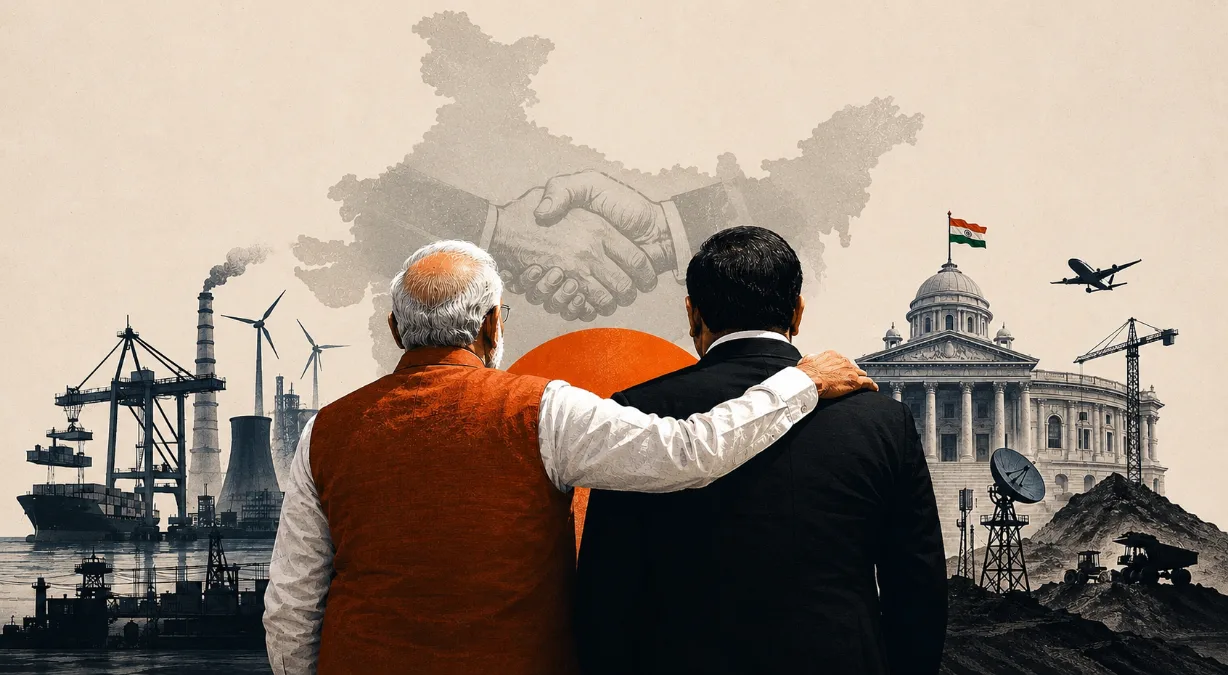
Introduction: A Symbiosis Disguised as a Success Story
There is a general narrative in the media that Gautam Adani is a self-made man, a school dropout from Ahmedabad who, through his hard work, built one of the world’s most formidable conglomerates from nothing. It is a compelling narrative, that fits into an authoritarian government’s propaganda framework about national renaissance and the unstoppable rise of a New India.
The problem is that it is a smartly manufactured myth designed to hide something far more troubling, a systematic, decade-long fusion of state power and private capital that economists and political scientists across the world recognise by its proper name: crony capitalism.
| Crony capitalism is an economic system where business success depends more on close political connections than on fair competition or innovation. In such a system, powerful corporations receive favorable treatment from governments through policies, contracts, licenses, or financial support. |
I. The Anatomy of an Unlikely Rise
To understand what makes the MoDani relationship so exceptional, and so dangerous, one must first understand the extraordinary velocity of Adani’s ascent.
Gautam Adani began his career trading commodities and established his first significant venture, the Mundra port in Gujarat, in 1998. For the first decade of his business life, he was a regional player, significant in Gujarat, but barely noticed at the national level. Then something changed.
In 2014, Narendra Modi, former Chief Minister of Gujarat, the very state where Adani had built his early empire, swept to power at the national level in an electoral landslide. What followed defies ordinary economic explanation.
Adani’s net worth shot up approximately 2,000 percent in the years following Modi’s ascension to power. His group expanded from ports into coal mining, airports, power generation, defense manufacturing, data centers, cement, food, and, most ominously, media. The flagship Adani Enterprises saw its share price rise more than 1,000 percent in just five years.
The speed of Adani’s rise maps almost perfectly onto the decade of Modi’s national rule. To call this a coincidence is to insult the intelligence of every Indian citizen.
II. The Gujarat Model: A Blueprint for Capture
The roots of the MoDani relationship predate Modi’s rise to national power. When Modi served as Gujarat’s Chief Minister from 2001 to 2014, he pioneered what became known as the “Gujarat model” of economic development.
Advocates presented this model as a victory of business-friendly governance and infrastructural efficiency. Critics, then and now, understood it for what it truly was: a system of governance in which state policy, regulatory frameworks, and the bureaucracy were served entirely to the profit interests of politically connected private corporations, with those industrialists closest to Modi positioned to benefit first and most generously.
The Mundra port, the Adani Group’s foundational asset, was located in Gujarat. The close personal relationship between Modi and Adani, both hailing from the same state, both embedded in the same networks of Gujarati business and BJP politics, was an open secret long before it became a subject of national and international scrutiny.
When Modi took this model national in 2014, Adani came with him. The Gujarat experiment in regulatory capture was simply scaled up to encompass the entire Indian economy.
III. The Airport Scandal: Rewarding Inexperience with Empire
Perhaps the most illustrative single example of how the MoDani relationship operates in practice is the extraordinary case of India’s airports.
In 2018, the Indian government made a controversial decision to allow private bidders to operate six major national airports simultaneously: Ahmedabad, Lucknow, Jaipur, Mangaluru, Guwahati, and Thiruvananthapuram.
The Adani Group won all six bids, despite possessing virtually no prior experience in airport management. The group’s only relevant qualification was the operation of a private airstrip at Mundra.
“From running a private airstrip at Mundra, the Adani Group’s transformation into the country’s largest private developer [of airports] happened over less than 24 months,” reported The Indian Express. This transformation did not happen in a vacuum. It happened because the government allowed it to happen, in defiance of its own expert advisors.
India’s Department of Economic Affairs, under the Finance Ministry, and the NITI Aayog, the government’s own economic think tank, had explicitly objected to allowing a single bidder to win more than two airports, citing the enormous financial risk of such concentration.
The government overrode these objections. No public explanation was offered for why the Adani Group, uniquely and without relevant experience, should be permitted to become overnight the country’s largest private airport operator. The southern state of Kerala’s finance minister was not subtle in his assessment: the decision was, he said, “an act of brazen cronyism.”
The pattern, government overriding its own expert safeguards to benefit Adani, would repeat itself throughout the decade.
IV. Coal, Forests, and the Exception That Proves the Rule
If the airport scandal illustrates the government’s willingness to bend procurement rules for Adani, the coal mining story reveals something even more damning: the Modi administration’s readiness to defy its own legal and moral conclusions in service of its favorite industrialist.
In 2014, the Supreme Court of India cancelled the allocations of 204 coal blocks, finding that they had been illegally distributed without legislative sanction under the previous Congress-led government. It was a landmark ruling, intended to end the era of opaque, politically directed resource allocation.
The Modi government, claiming the mantle of anti-corruption reform, introduced new regulations in the aftermath of this ruling. But here is where the story takes a turn: the government’s own Prime Minister’s Office determined that a particular regulation handing coal blocks to the private sector was, in its own words, “inappropriate” and lacking in transparency.
And then the government made an exception, for Adani.
Documents accessed by investigative journalists at The Reporters’ Collective and Al Jazeera reveal that the Modi government allowed Adani Enterprises Limited to continue mining from a block holding more than 450 million tonnes of coal in one of India’s densest forest patches, an exception explicitly carved out for Adani, without public explanation, after the government had itself concluded that such arrangements were inappropriate. To date, the company has extracted more than 80 million tonnes of coal from this block alone.
The Adani Group went on to become the largest coal Mine Developer and Operator (MDO) in India, holding nine MDO contracts for blocks containing more than 2.8 billion tonnes of coal. The group has won more coal mining contracts from state-owned players than any other private entity. Two of these contracts were signed directly by BJP-ruled state-owned companies.
In 2020, when the central government proposed amendments to the country’s mining laws to make it easier for private companies to extract and sell coal, critics observed that the primary beneficiary of these changes was, unsurprisingly, the Adani Group.
The pattern is unmistakable: public resources, built over generations by India’s citizens, converted into private wealth for a single politically connected family, at prices critics argue were far below market value, often financed through loans from India’s public sector banks.
V. The US Indictment: When Crony Capitalism Goes International
Whatever doubts might remain about the domestic dimensions of the MoDani relationship, the events of late 2024 shattered any pretense that this was merely a matter of political interpretation.
In November 2024, American federal prosecutors in New York issued a criminal indictment accusing Gautam Adani and several senior executives of his group of paying more than $265 million in bribes to Indian government officials between 2020 and 2024, in order to secure lucrative solar energy contracts from the Solar Energy Corporation of India (SECI) and state electricity distribution companies.
The charges included securities fraud and wire fraud, with allegations that the companies had deliberately concealed this bribery scheme from investors in the United States and elsewhere.
The FBI reportedly uncovered the evidence during a 2023 investigation, including what prosecutors described as “bribe notes” tracked on electronic devices and detailed “corrupt payment analyses.” The allegations suggested a systematic, documented operation of state capture, not random corruption, but organized, institutionalized bribery embedded in the architecture of India’s energy sector.
The consequences were severe. Adani Group shares collapsed. Adani Enterprises lost more than a quarter of its market capitalization in days, with frenzied selling triggering multiple trading halts. Kenya’s President William Ruto cancelled a $736 million public-private partnership with the Adani Group, including a power transmission project and a 30-year control deal for the country’s main airport. The fallout spread across international markets and governments.
The Modi government’s response? Silence. A studied, deliberate, institutional silence. The Prime Minister who had championed Adani as an icon of Indian entrepreneurship offered no comment, no investigation, no accountability mechanism of any kind.
VI. Foreign Policy as Personal Protection
Crony capitalism in its most common form involves domestic corruption: contracts, licenses, regulatory favors. What distinguishes the MoDani case, and what elevates it from ordinary corruption into something genuinely alarming, is the apparent use of India’s sovereign foreign policy as an instrument of personal protection for one private businessman.
The evidence here is circumstantial but compelling in its accumulation.
The Adani Group’s international expansion, into ports, airports, electricity, coal mining, and defense, across countries including Australia, Bangladesh, Vietnam, Greece, Indonesia, Israel, Kenya, Nepal, and Sri Lanka, has tracked closely with Modi’s diplomatic engagements with those countries. Adani has frequently accompanied Modi on his foreign visits.
The Godda power project in Bangladesh is perhaps the most stark example. When Sheikh Hasina was Prime Minister of Bangladesh, the Adani Group reached a deal to generate 1,600 MW of power at Godda in India and transmit the electricity to the neighboring country, with coal reportedly imported from Adani’s Australian mines.
The project was widely described as a “sweetheart deal”, its electricity pricing considered exorbitant by independent analysts, in exchange for Modi’s political and diplomatic backing of Hasina, who faced Western pressure over democratic backsliding and human rights abuses. When a popular uprising toppled the India-friendly Hasina government and she fled to India, the project immediately faced turmoil and allegations of exploitative pricing.
Similarly, after Modi cultivated close ties with Israeli Prime Minister Benjamin Netanyahu, the Adani Group acquired Israel’s Haifa port, trading on India’s burgeoning military-security partnership with Israel as business currency.
Most damning of all is the question of what happened, and what did not happen, in the aftermath of the US indictment. After a well-timed and high-profile investment pledge by the Adani Group in the United States, American prosecutors quietly allowed the indictment to stall. A US criminal prosecution that legal experts described as a career-ending indictment appeared to soften after a business negotiation. Foreign policy, it seems, bends in the direction of one man’s balance sheet.
VII. Silencing the Press: The NDTV Takeover
A functioning democracy cannot survive without a free press. It is not accidental, then, that the MoDani project has systematically targeted India’s independent media.
In August 2022, the Adani Group’s media venture, AMG Media Networks, announced a hostile bid for New Delhi Television (NDTV), widely regarded as India’s most credible and editorially independent news broadcaster, and one of the rare outlets consistently critical of the Modi government. The NDTV founders, Prannoy Roy and Radhika Roy, stated explicitly that they were neither aware of the transaction nor had they consented to it. They eventually sold their remaining shares and resigned from the board.
The chilling effect was immediate. When Hindenburg Research’s explosive report on the Adani Group was published in January 2023, NDTV, now under Adani ownership, maintained a studied silence on the controversy for two full days before publishing brief, anodyne wire copy. Prominent journalists who had built their careers at NDTV resigned. Award-winning anchor Ravish Kumar, one of India’s most respected voices in broadcast journalism, left a network he had served for 26 years.
Media ownership experts were unambiguous: with this acquisition, the last significant private news channel in India had fallen under ownership aligned with the ruling government. In 2014, Mukesh Ambani, another Modi-aligned billionaire, had acquired Network18, one of India’s largest media companies. The Adani acquisition of NDTV completed the picture.
India’s press freedom ranking under Modi has been catastrophic. The country now sits at 150 out of 180 nations in Reporters Without Borders’ global press freedom index. The consolidation of media ownership in the hands of government-friendly billionaires is not incidental to this ranking. It is its explanation.
The implications are profound and recursive: crony capitalism is sustained by the absence of accountability. The absence of accountability requires the silencing of those who would provide it. The silencing of the press is, therefore, not merely a byproduct of the MoDani relationship, it is one of its necessary conditions.
VIII. Democratic Institutions and the Architecture of Impunity
What most distinguishes the MoDani case from previous episodes of Indian crony capitalism, and there have been many, under governments of all political orientations, is not the corruption itself, but the comprehensive dismantling of the institutional checks that might have constrained it.
India’s Securities and Exchange Board (SEBI), its market regulator, conducted an investigation into the Adani Group following the Hindenburg allegations of stock manipulation and accounting fraud. The investigation was widely criticized as slow, limited in scope, and ultimately inconclusive. SEBI’s chairperson herself later came under scrutiny for alleged conflicts of interest related to offshore entities connected to the Adani Group, a revelation that undermined public confidence in the regulator’s independence even further.
India’s Central Bureau of Investigation (CBI) and Enforcement Directorate (ED), the agencies responsible for investigating financial crime at the national level, have demonstrated a remarkable pattern of selective enforcement under the Modi government. These agencies have aggressively pursued opposition politicians, critical journalists, and civil society organizations, while maintaining a conspicuous silence regarding the allegations surrounding the Adani Group.
The Supreme Court, in a rare intervention, took cognizance of petitions demanding an independent investigation. But the investigation it subsequently ordered remained within the framework of SEBI, the very regulator whose independence was already compromised.
The Modi government, meanwhile, signaled its tolerance for no dissent on these matters. When non-profits raised questions about infrastructure development, the government announced it would remove registrations from organizations that “opposed development.” When the US Hindenburg report shook global markets, Modi characterized criticism of Adani as criticism of India itself, a rhetorical maneuver designed to make accountability unpatriotic.
This is the architecture of impunity: a hollowed-out regulatory ecosystem, captured media, intimidated judiciary, and a political vocabulary that converts corruption into nationalism.
IX. The Real Cost: What India Has Lost
The MoDani relationship is not merely a story about two powerful men and the deals they made. It is a story about what happens to ordinary Indians, and to the idea of India itself, when the state is captured by private interests.
India’s public sector banks have extended enormous loans to the Adani Group. These are not private banks risking private capital; they are institutions whose deposits belong to ordinary Indian citizens, whose exposure to a single conglomerate represents a systemic risk that regulators in any functioning democracy would have flagged and constrained.
Public infrastructure, ports, airports, power grids, coal mines, built over decades through public investment and public sacrifice, has been privatized and delivered to a politically connected operator at prices critics describe as far below genuine market value. The proceeds of this privatization have not flowed back to India’s public health system, its schools, or its crumbling infrastructure in the rural hinterland. They have flowed into the balance sheet of a single family.
Meanwhile, India’s aspiration to be seen as a trustworthy destination for foreign investment has been severely damaged. When a US indictment alleges systemic bribery across India’s energy sector, when Kenya cancels contracts citing corruption, when international investors watch an entire conglomerate’s market capitalization collapse in days, the message to the global investment community is unambiguous. India’s regulatory environment cannot be trusted. Its procurement processes are for sale.
Conclusion: India Deserves Better
Crony capitalism is not new. India has always had it. Congress-era corruption, coal block allocations, license raj, the cozy relationship between socialist policy and business favoritism, is well-documented and rightly condemned. The critics of MoDani are not naive enough to imagine that India was ever a pristine meritocracy.
But something qualitatively new has happened under the Modi-Adani axis. The scale is unprecedented. The velocity is unprecedented. The use of foreign policy as a personal protection mechanism has no real precedent. The systematic destruction of institutional checks, regulators, press, civil society, that might have constrained the relationship has no real precedent.
And above all, the impunity is unprecedented. When a US criminal indictment for paying $265 million in bribes to government officials produces no response from the government of those officials, not an investigation, not a statement, not a pretense of accountability, something has broken at the foundation of Indian democratic governance.
India is a country of 1.4 billion people, with a Constitution that guarantees equality before the law, a free press, and independent institutions. What the MoDani relationship represents is the systematic betrayal of each of those guarantees, engineered at the highest levels of government, with the resources of the Indian state deployed in service of one private fortune.
The citizens of India, the farmers, teachers, factory workers, and small traders who have no billionaire to call, no government official to bribe, no foreign minister to ease their path, deserve a state that works for them. What they have received instead is a state that has been rented out.
History will not be kind to this arrangement. The only question is whether accountability will arrive in time to save India’s democratic institutions, or whether the architecture of impunity will prove sturdy enough to outlast it.