
A live television debate has ignited one of the most unusual media controversies of the year and this time, the pushback is not coming from politicians or Bollywood stars, but from teachers.
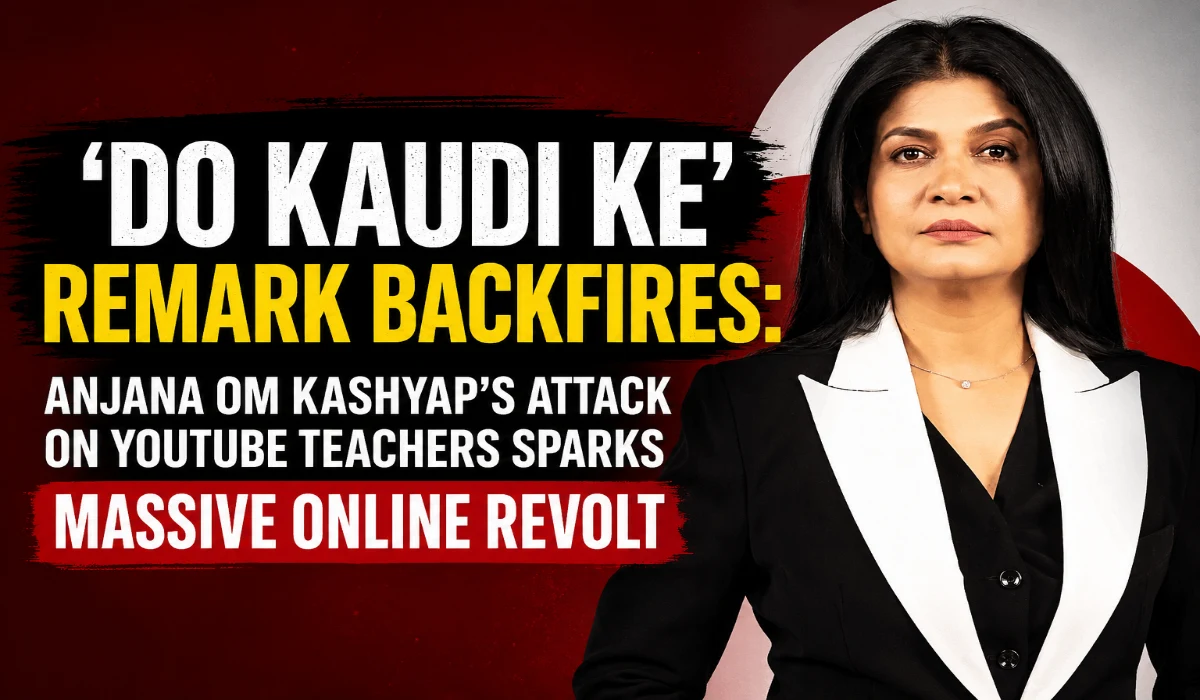
Senior TV journalist and managing editor Anjana Om Kashyap sparked a fierce nationwide backlash after she publicly dismissed India’s YouTube educators as frauds during a primetime broadcast on May 29–30, 2026. The remarks, which spread rapidly across social media, have triggered a wave of responses from some of the country’s most-followed online educators and the millions of students who rely on them.
What She Said
During the live debate, Kashyap accused YouTube teachers of having no real knowledge, claiming they sketch things on blackboards not to teach but to “grab views, do drama, and make money.” She used the Hindi phrase “do kaudi ke” – roughly meaning “not worth two pennies” – to describe them, adding that despite knowing nothing, these creators had started believing they were important voices on every subject.
The clip was clipped and circulated widely within hours, drawing immediate reactions from the online education community.
Educators Strike Back
Among the first to respond was Abhinay Sharma, widely known as Abhinay Sir, the founder of the popular Abhinay Maths channel. He posed a straightforward question: if YouTube teachers know nothing, then who has been preparing millions of aspirants for JEE, NEET, SSC, and UPSC over the last several years? It was not a rhetorical question. For vast sections of India – particularly in smaller towns and semi-urban areas where private coaching is simply unaffordable – YouTube education has long served as the primary and often the only credible means of exam preparation.
Suman Mam, who teaches through the Ocean Gurukuls platform, went further in her response. She noted that she conducts free marathon sessions on YouTube for students who cannot pay a rupee for coaching, and questioned why an anchor seated in an air-conditioned studio was branding her and her colleagues as frauds. She also called attention to a pattern she described as mainstream television prioritising TRP-driven drama over serious issues like paper leaks and student unemployment.
References to Khan Sir – the Patna-based educator with tens of millions of followers also surfaced prominently across the backlash, with many online commentators noting that his recent public criticism of certain media practices may have played a role in the timing of the remarks, though no formal connection has been established.
Khan Sir Responce
Why Students Are Angry
The sheer volume of student responses – spreading across Twitter, Instagram, YouTube, and Facebook over a 24-hour window set this controversy apart from the usual television blowups. These were not anonymous trolls. Thousands of students from Bihar, Uttar Pradesh, Rajasthan, Jharkhand, and other states came forward with personal accounts of how a YouTube teacher had helped them clear an exam, grasp a difficult concept, or simply hold on through months of gruelling preparation.
The COVID-19 period loomed large in many of these accounts. When schools shut and coaching centres closed their doors, it was YouTube educators who continued teaching. For a generation of competitive exam aspirants, that memory is not abstract — it is lived experience. The suggestion that those people were frauds felt, to many, like a personal insult.
The phrase “do kaudi ke” landed with particular force. Not for being unusually harsh in itself, but because it was aimed at educators who, in the eyes of their students, had handed them something of immense value: a genuine chance at clearing a government exam and changing the course of their lives.
A Deeper Fault Line
The controversy points to something older and more complicated – a growing mistrust between mainstream television news and the digital education ecosystem that has expanded significantly over the past decade.
Hindi news television has faced persistent criticism for prioritising spectacle over substance, staging loud debates that generate noise without informing anyone, and rarely engaging seriously with ground-level realities. YouTube educators, many of them products of the very competitive exam system they now teach, have built audiences numbering in the tens of millions, often through a simpler approach: explaining things clearly and honestly to people who actually need the knowledge.
The irony was not lost on commentators online. A medium that has itself repeatedly faced questions over credibility and editorial responsibility was now accusing another of being driven by greed and deception.
None of this means that the online education space is beyond criticism. There are YouTube channels that overpromise, manipulate students emotionally, and charge for courses that deliver little of value. A serious, fact-based conversation about accountability in digital education would be entirely worthwhile. But Kashyap’s remarks did not target specific bad actors. They applied a single dismissive brush to an entire community – hundreds of educators and millions of students and that is what drew the intensity of response now unfolding online.
No Apology So Far
As of May 31, 2026, neither Anjana Om Kashyap nor the channel that aired the debate has issued any public apology or clarification. The hashtag continues to trend on social media, with educator rebuttal videos stacking up alongside personal student testimonials.
The silence from the studio side is being read differently by different observers. Some see it as standard practice – waiting for the storm to pass. Others argue that this particular storm, driven not by outrage but by personal experience shared by millions of ordinary people, may not pass so quietly.
The question at the centre of this debate has now moved well beyond the original clip: who is actually serving India’s students, and who gets to pass judgment on that? As it turns out, millions of young people across the country feel very strongly about the answer.