
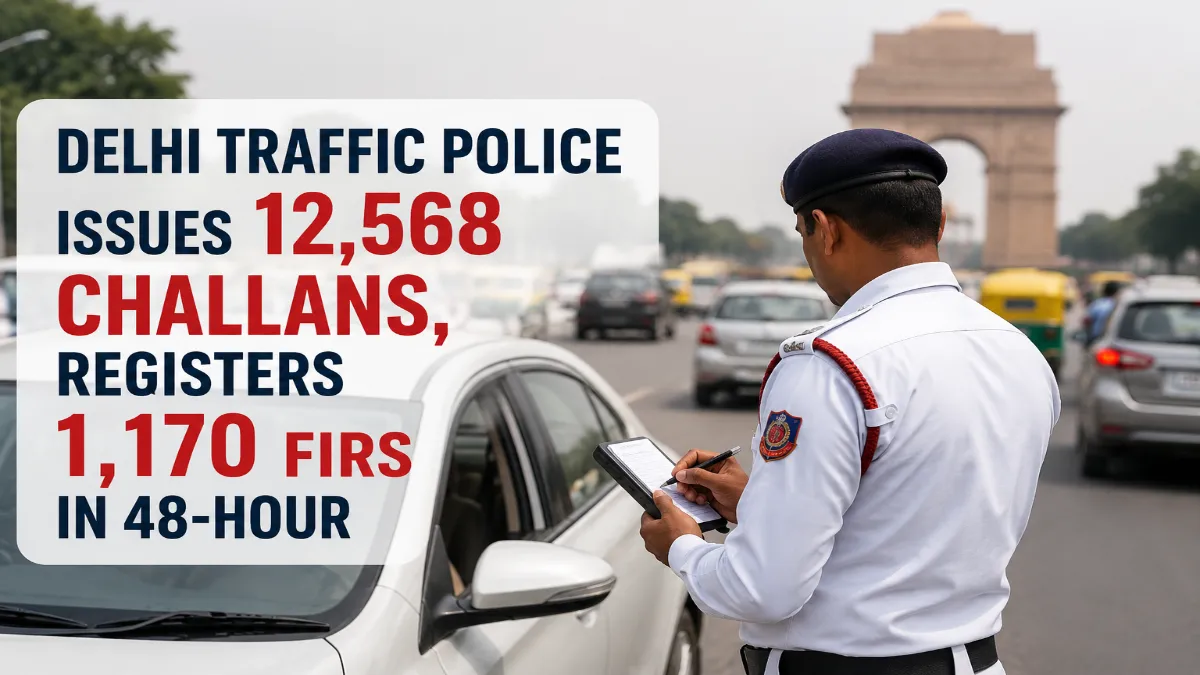
In a sweeping two-day enforcement operation conducted across the national capital on May 22 and 23, the Delhi Traffic Police registered 1,170 FIRs, impounded 1,179 vehicles, and slapped 12,568 challans on motorists caught driving on the wrong side of the road. The crackdown – one of the sharpest traffic enforcement blitzes the city has witnessed – signals that Delhi Police has moved well beyond fines and warnings.
If you drive in Delhi, the last two days should serve as a wake-up call.
Wrong-side driving is now a criminal offence.
Content
The Numbers That Should Make You Rethink Your Shortcut
The two-day figures are alarming on their own. But zoom out to the full year, and the scale of enforcement becomes staggering.
According to official Delhi Traffic Police data available till May 24, 2026:
- 1,09,240 challans issued against wrong-side violators since January
- 88,060 traffic notices sent to vehicle owners
- 1,578 FIRs (criminal cases) registered in 2026 alone
The month of May tells the sharpest story. While the entire January to April period saw just 186 FIRs, May alone – with its special enforcement drives – clocked 1,392 FIRs and 27,652 challans in just 24 days. That is not a gradual increase. That is a deliberate escalation.
Why This Is Different From Earlier Crackdowns
For years, wrong-side driving in Delhi was effectively managed with a monetary slap – a fine, sometimes a licence suspension, rarely anything more. That has fundamentally changed.
Delhi Traffic Police has begun invoking Section 281 of the Bharatiya Nyaya Sanhita (BNS) – which deals with rash and negligent driving – alongside provisions of the Motor Vehicles Act. The result: a traffic violation can now lead to arrest, criminal prosecution, and imprisonment, not just a challan.
“Wrong-side driving is not merely a traffic violation. It is a grave and life-threatening offence that endangers innocent road users and severely disrupts traffic flow,” a senior Delhi Traffic Police officer said, adding that enforcement through criminal cases, vehicle seizure, and prosecution would continue without pause.
The crackdown is part of a renewed enforcement strategy launched in late December 2025, specifically designed to address the growing number of head-on collisions, fatalities, and traffic disruptions caused by wrong-side driving on Delhi’s arterial roads.
If You Drive in Delhi – Read This Carefully
The crackdown extends beyond wrong-side driving. With AI-enabled cameras, body-worn devices on traffic personnel, and e-challan technology now fully operational across the city, the chances of escaping a violation undetected have dropped dramatically. Here is everything you need to know to stay on the right side of the law, and what to do if you don’t.
The Do’s: How to Keep Yourself Challan-Free
Carry your documents always.
The most avoidable reason for a roadside challan is missing paperwork. You must have your Driving Licence, RC (Registration Certificate), valid insurance, and a current PUC (Pollution Under Control) certificate. The good news: the DigiLocker and mParivahan apps carry legally valid digital copies. You do not need physical documents if you have these apps properly linked with your Aadhaar and the VAHAN database.
Check for pending e-challans regularly.
CCTV cameras in Delhi auto-generate challans and send them to your registered mobile number. Many motorists remain unaware of pending dues until their vehicle is detained at a check post. Visit echallan.parivahan.gov.in or open the mParivahan app, enter your vehicle or DL number, and check immediately. Unpaid challans compound over time – and can result in your vehicle being seized on the spot during the next routine check.
Respect one-way and road direction, no exceptions.
The May operation targeted this specifically. No shortcut, no U-turn avoidance, and no “just this once” justification is worth a criminal FIR. Delhi’s key enforcement hotspots include Ring Road, Outer Ring Road, NH-48 corridor, and major South and West Delhi arterials. These are under CCTV and patrolled by dedicated enforcement squads.
Keep your PUC current.
PUC certificates lapse every 3–6 months, depending on your vehicle’s age and fuel type. Driving without a valid PUC attracts a fine of ₹10,000 for the first offence, and ₹10,000 plus up to three months in jail for a repeat. Renew proactively. Most petrol pumps in Delhi offer PUC testing for under ₹100.
Use authorised parking.
Vehicles parked in no-parking zones are towed by traffic police or MCD-authorised agencies. Getting your vehicle released means a towing charge (₹500–₹2,000), paying the challan, and often a half-day’s trip to the nearest police pound. Avoid the hassle entirely.
The Don’ts: Mistakes That Make Things Far Worse
Never argue with a traffic cop at the spot.
This is where many situations go from bad to very bad. Arguing with, abusing, or physically resisting a traffic officer in the course of their duty can result in a fresh FIR for obstruction of a public servant or criminal intimidation, on top of the original challan. Accept the challan receipt calmly. You can contest it legally afterwards; that avenue exists and is effective.
Do not offer or pay a bribe.
Bribing a traffic officer is illegal for both parties involved. If a cop demands a bribe, note down their badge number, vehicle/beat number, and the exact time and location. File a complaint at the Delhi Traffic Police Vigilance line (+91-11-23490009) or the national Anti-Corruption Helpline (1031). Many personnel now wear body cameras; the interaction may already be on record.
Do not ignore an e-challan.
Challans do not expire or disappear. They accumulate in the system against your vehicle number. The next time your vehicle is stopped, for any reason at all, all pending challans come due instantly, and the vehicle can be impounded on the spot. Pay early, pay online.
Do not drink and drive at all.
Delhi’s drunk-driving enforcement has zero practical tolerance at active checkpoints. The legal blood alcohol limit is 30 mg per 100 ml. The penalties: ₹10,000 and/or six months imprisonment for the first offence, ₹15,000 and/or two years for a repeat, plus vehicle seizure and licence suspension. There is no negotiating with a breath analyser result.
Do not use your phone while driving, even at a red light.
The penalty is ₹5,000. AI cameras deployed across key Delhi corridors can now detect a handheld phone through a vehicle’s windshield. Holding your phone at a red light qualifies as a violation under the Motor Vehicles Act. Use a hands-free mount or simply put the phone away.
Do not skip court dates if an FIR has been filed.
If you received an FIR, especially under BNS Section 281 for wrong-side or rash driving missing the hearing date can result in a non-bailable warrant being issued in your name. Engage a lawyer immediately. Dedicated traffic courts operate at Saket, Rohini, Dwarka, and other district court complexes in Delhi.
How to Pay a Delhi Traffic Challan
Online (takes under 5 minutes):
- Go to echallan.parivahan.gov.in
- Click “Check Challan Status”
- Enter your vehicle number, DL number, or challan number
- View pending challans
- Click Pay Now. Payment is accepted via UPI, net banking, and debit/credit cards. Save the transaction ID as proof.
Offline:
Visit any Delhi Traffic Police e-Seva Kendra (available at police stations across all districts), designated banks listed on the challan slip, or Traffic Police counters at ITO, Red Fort, and Mandir Marg.
Got a Wrong Challan? Here’s How to Contest It
Camera-generated challans sometimes capture incorrect vehicle numbers or flag vehicles not at the scene. You have a legal right to contest. Here is how:
Gather the challan number, date, time, and violation details. Collect any counter-evidence, dashcam footage, photos, or witness accounts. For camera-generated e-challans with a clerical vehicle number error, file a grievance directly at echallan.parivahan.gov.in under the Grievance section, or email helpdesk-dtp@nic.in. For a more substantive dispute, appear at the traffic magistrate court on the date mentioned in your challan notice. A lawyer is not mandatory for minor violations, but is advisable for FIR-level cases.
Vehicle Impounded? Follow These Steps
If your vehicle has been seized, the storage (pound) charges quickly accumulate daily.
Get the seizure memo from the police officer at the time of impoundment. Pay all pending challans online or at an e-Seva Kendra. Appear before the duty Magistrate at the relevant Traffic Court with the seizure memo, your documents, and payment receipts. The Magistrate will issue a release order. Carry that order to the police pound where your vehicle is held. Pay the pound storage fee (₹50-₹200 per day, depending on vehicle category). The vehicle is released upon document verification.
Key Contacts and Resources
| Service | Details |
|---|---|
| Delhi Traffic Police Helpline | 1095 |
| Emergency | 112 |
| Anti-Corruption / Anti-Bribery | 1031 |
| Traffic Police Vigilance | +91-11-23490009 |
| E-Challan Portal | echallan.parivahan.gov.in |
| mParivahan App | iOS & Android |
| Delhi Traffic Police | delhitrafficpolice.nic.in |
| DigiLocker | digilocker.gov.in |
The Bottom Line
Delhi’s traffic enforcement in 2026 is operating at a different level altogether. Over a lakh challans, 1,578 criminal cases, body cameras on cops, AI surveillance on roads, and a Supreme Court-backed framework that treats wrong-side driving as a criminal act, the old calculus of “take the shortcut, pay a small fine if caught” simply does not work anymore.
The smartest move for any Delhi driver is uncomplicated: follow the traffic rules, keep your documents in order, check for pending challans regularly, and if you do get one, pay it promptly or contest it through the proper legal channel. Every other option is costlier.
Resources: Delhi Traffic Police official data, PTI, Devdiscourse. This article is for informational purposes and does not constitute legal advice.