
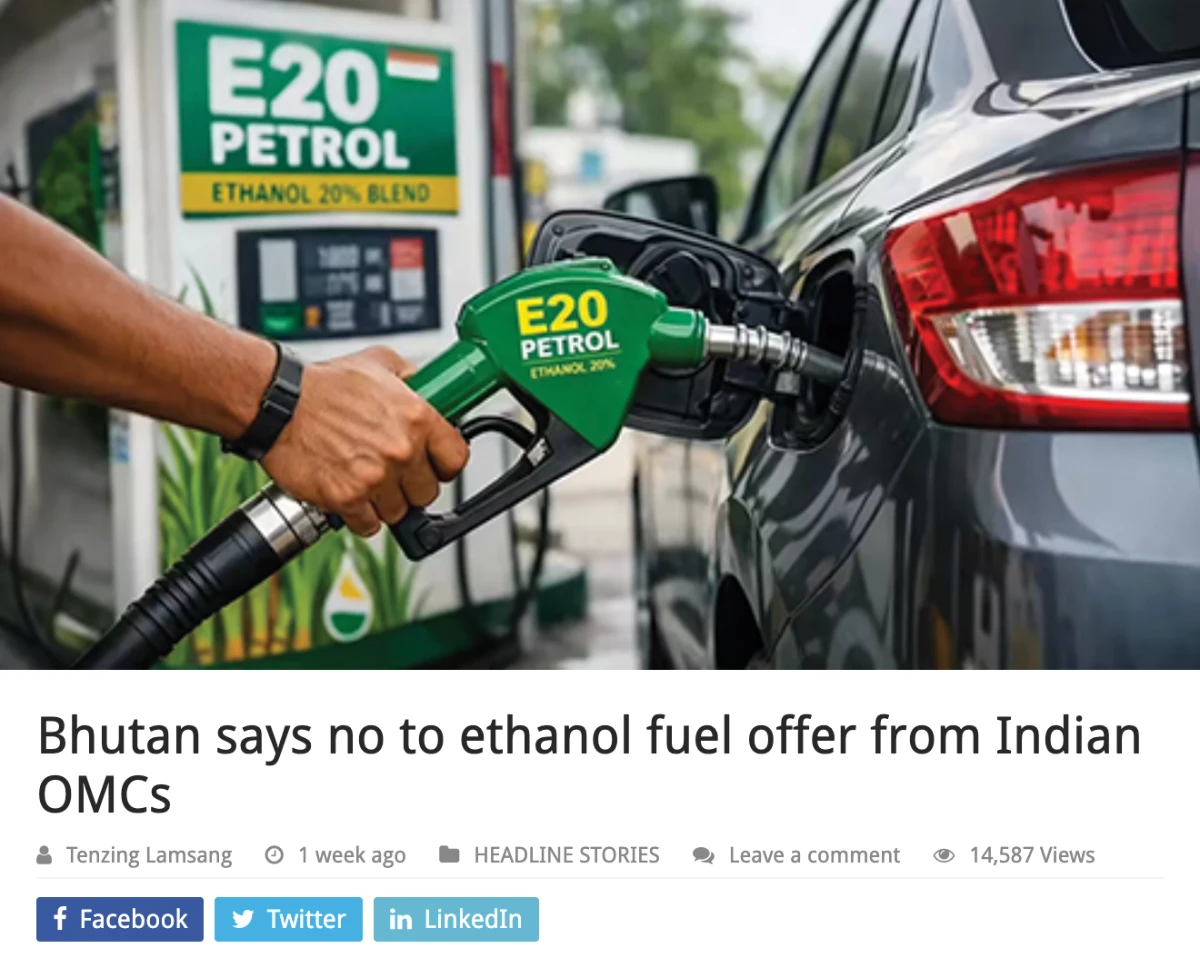
A war of words has broken out between a senior Bhutanese journalist and India’s Ministry of Petroleum and Natural Gas over whether Indian Oil Marketing Companies (OMCs) offered to supply E20 (20% ethanol-blended) petrol to Bhutan — and whether Bhutan turned it down.
How It Started
Tenzing Lamsang, editor of The Bhutanese, reported last week that Bhutan had politely declined an offer from Indian OMCs to supply E20 petrol. Citing sources, his paper said Bhutan’s decision came down to ethanol’s hygroscopic nature — its tendency to absorb moisture — which could pose serious problems given the country’s old and potentially leaky underground storage tanks, especially in its Himalayan terrain.
Lamsang first flagged the report on X (formerly Twitter) on July 3, saying Bhutan lacked the storage infrastructure needed for such a moisture-sensitive fuel.
The Government Pushes Back
Two days later, on July 5, India’s Ministry of Petroleum and Natural Gas issued a fact-check on its official X handle, calling the report “incorrect.” The ministry stated flatly that no OMC had made any such offer, and that no proposal to export E20 to Bhutan existed at all. It urged the public to rely only on official government sources.
Editor Stands His Ground
Lamsang didn’t back down. In response, he posted what he described as a written reply from Bhutan’s Department of Trade — a document he said confirmed that Indian OMCs had indeed raised the subject of E20 during technical-level meetings, and that Bhutan’s Department of Trade had responded by asking the companies to continue supplying regular petrol instead. Lamsang added that his own verbal interviews with officials backed up this version of events.
Where the Dispute Actually Lies
Here’s the crux of the disagreement: the document Lamsang shared reportedly does not use the specific words “formal offer” or “proposal” — which is exactly the technical ground on which the ministry is basing its denial. The document does, however, reportedly detail Bhutan’s concerns about its fuel storage tanks, and notes that Bhutan has asked India to give advance notice if it eventually moves to a fully ethanol-blended petrol regime, so local fuel dealers have time to upgrade their tanks.
Adding weight to the storage concerns, Bhutan’s largest fuel distributor, Tashi BOD, has separately said its stations currently aren’t equipped to handle ethanol-blended fuel because of the same seepage problem.
The Bigger Picture
The spat comes at a time when India’s own domestic E20 rollout is facing scrutiny, with users reporting reduced mileage and increased vehicle wear.
Notably, neither Lamsang nor the ministry has released the full document publicly. That means the central question — whether an offer was formally extended or merely raised informally during talks — remains unresolved.