

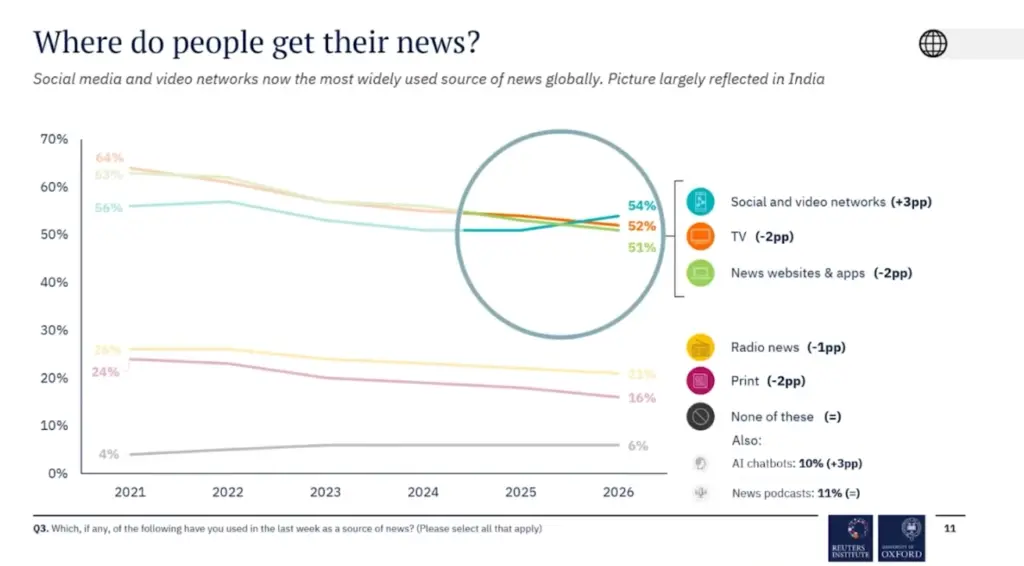
For the first time in history, social media and video networks have surpassed both television and news organisations’ own websites as the most widely used source of news globally, a landmark finding from the Reuters Institute Digital News Report 2026, the world’s most comprehensive annual study of news consumption, published by the Reuters Institute for the Study of Journalism at the University of Oxford.
The report, now in its fifteenth year, finds that 54% of people worldwide use social media and video networks to access online news, ahead of news organisations’ own websites and apps, used by 51%, and television news, used by 52%. When AI chatbots are added to this figure, the combined share of third-party news consumption rises to 56%.
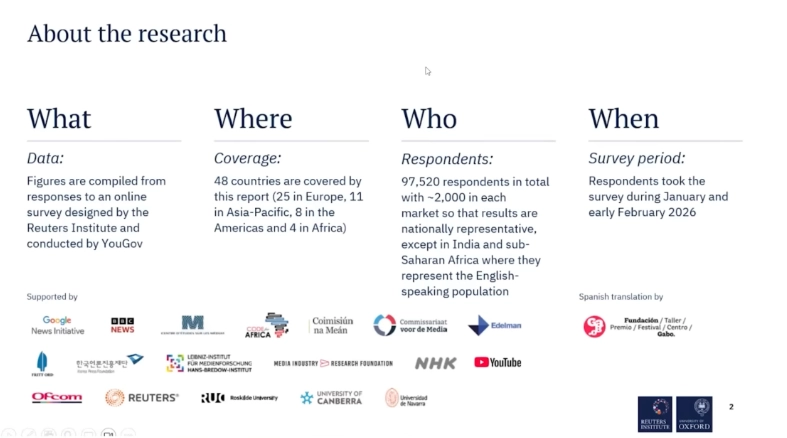
The report covers 48 markets and is authored by lead author Jim Egan, with data collected from approximately 2,000 respondents per market.
Platforms Now Rule: A Turning Point for Global Journalism
The use of both TV news and news organisations’ websites and apps has fallen by 13 and 12 percentage points respectively since 2020. The proportion of people who say social media and video networks are their main source of news has also grown, from 22% five years ago to 30% globally in 2026.
In 30 of the 48 markets surveyed, social media and video networks are now more popular as a news source than owned and operated news websites and apps. Among young people aged 18-24, more than half (52%), say social media, video networks, and AI chatbots are their primary way of getting news, a figure 32 percentage points higher than any other source.
The shift is particularly sharp in countries like Indonesia, where the proportion citing social media as their main news source rose by 8 percentage points to 48%, while even traditionally restrained markets like Germany saw a 4-percentage-point increase.
AI Chatbots: A Growing but Cautious Frontier
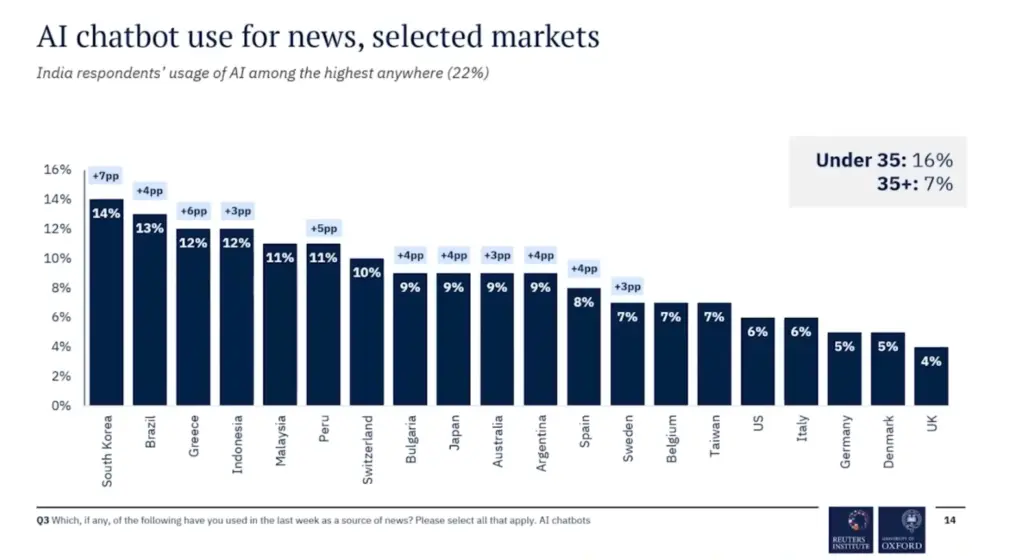
The weekly use of AI chatbots such as ChatGPT, Perplexity, and Google Gemini for news rose from 7% to 10% globally year-on-year. Usage is concentrated among younger, digitally engaged audiences, 16% of those under 35 report using AI chatbots for news.
South Korea, Greece, and Spain all saw AI chatbot use for news double year-on-year, while several major markets including the USA, UK, France, and Germany recorded no increase.
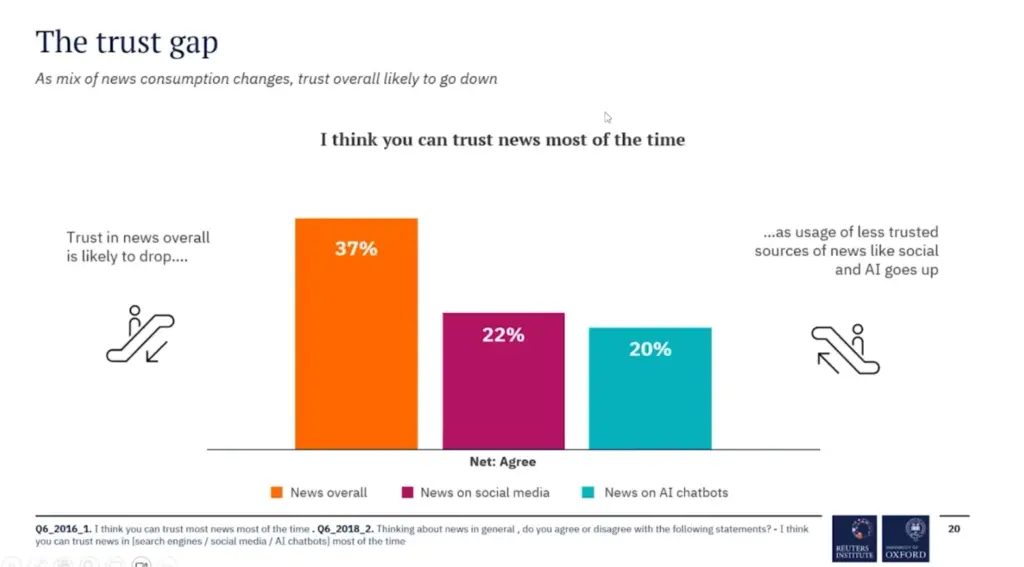
Trust in AI chatbot news answers stands at just 20% globally, compared to an overall news trust figure of 37%. In the UK, trust in AI chatbot answers is as low as 6%, the lowest of any market surveyed.
The most popular feature cited by AI chatbot news users is the ability to ask follow-up questions, cited by 42% of respondents.
Online Video Now Majority Sport in All 48 Markets
For the first time, a majority of people across all 48 markets covered by the report now watch online news video, 77% of global respondents consume online news video each week. In 45 of these markets, more people now watch online news video than watch traditional broadcast TV news. Only Germany, Denmark, and the Netherlands remain exceptions where TV news leads or is on par with online video.
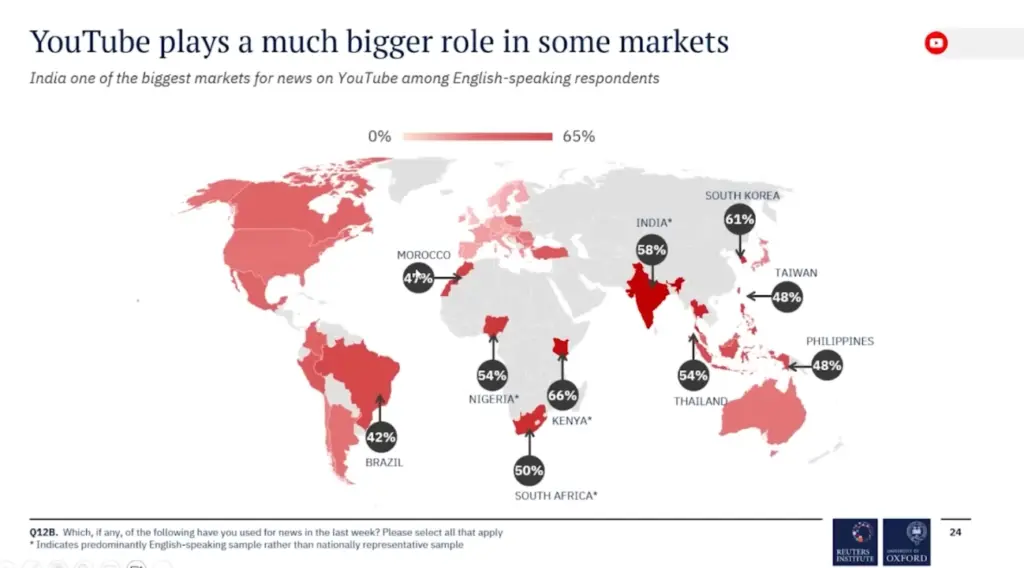
Facebook remains the largest platform overall for news consumption globally, used by 43% of respondents, reversing recent declines. YouTube is used by 34% for news, Instagram by 26%, and TikTok by 20%, with TikTok growing fastest from a smaller base. India and Kenya rank among the highest users of YouTube for news worldwide.
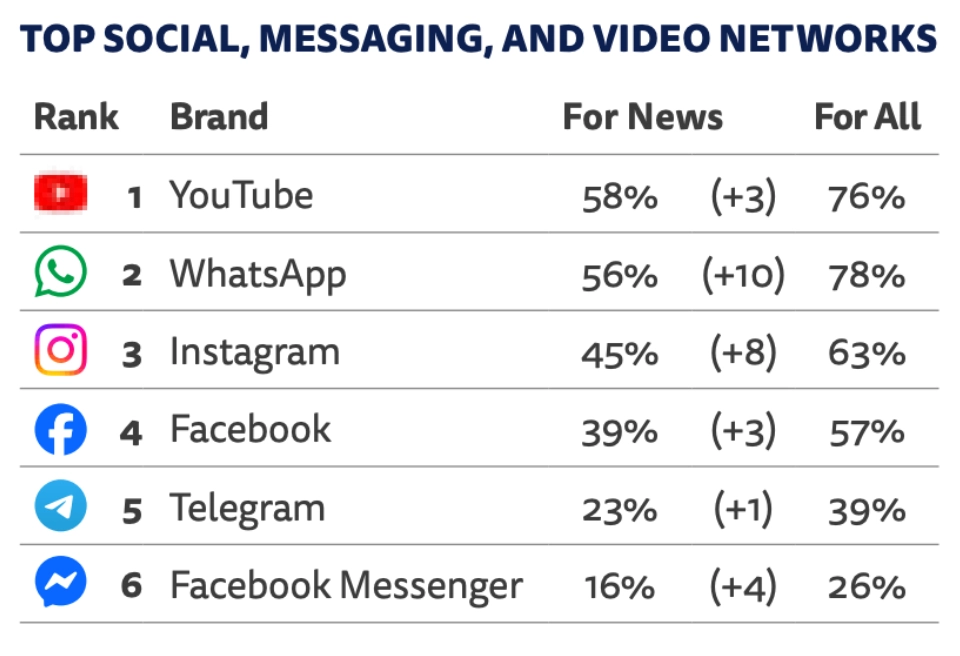
Critically, growth in online video is overwhelmingly happening on third-party platforms. At the global level, video consumption on news organisations’ own websites and apps fell by 5 percentage points last year, to just 23%.
Trust in News Hits Record Low
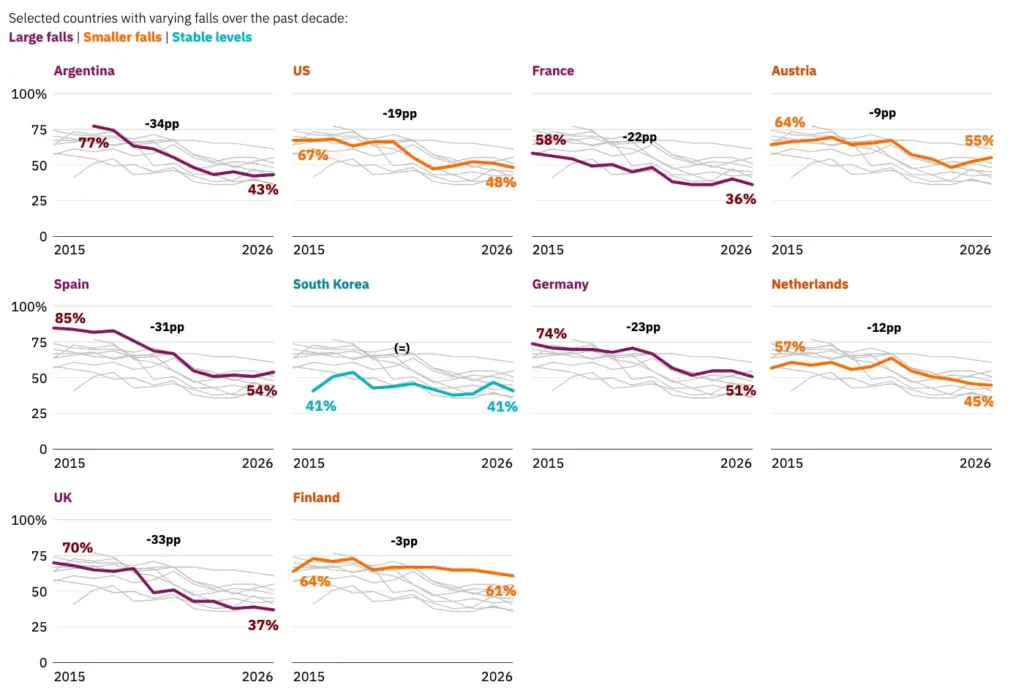
In a troubling sign for the global journalism industry, trust in news fell in 29 of the 48 markets surveyed this year, dropping to 37% overall, the lowest recorded figure since the Reuters Institute began measuring trust in 2015. Trust fell by 5 percentage points or more in 19 markets.
In the United States, only 25% of people now say they trust the news most of the time, placing the US seventh-lowest in the global survey. Among right-leaning Americans, that figure drops to just 15%.
Countries showing the steepest trust declines include the Philippines, Thailand, Peru, and Poland, with common factors including political instability, divisive elections, and increasingly fragmented information environments.
Despite this, trust in individual, widely-used news brands has held up better than trust in news overall, suggesting audiences continue to distinguish between trusted outlets and the broader news ecosystem.
Misinformation Fears Surge
Concerns about fake news and misinformation online rose 4 percentage points to 62% of respondents globally. In Western Europe, every single market recorded an increase in fake news concern of at least 4 percentage points, rising to 7 points in Norway, 8 in the Netherlands, and 9 in Belgium.
Worries about misinformation remain highest in Nigeria and Kenya, followed by the UK, Australia, and Portugal.
News Creators on the Rise
Around 27% of respondents globally say they accessed news from news-focused individual creators or influencers in the past week. When broader content creators who occasionally discuss current affairs are included, the figure rises to 46%.
Respondents describe creators as more entertaining, easier to understand, and more relatable than traditional news outlets — though on average they are considered less trustworthy and less impartial.
For the vast majority of audiences, creator consumption is complementary rather than a replacement for traditional news, only 3% of people globally rely solely on creators for all their news needs.
Interest in News Declining
Since 2021, the proportion of people who describe themselves as extremely or very interested in the news has fallen by an average of 13 percentage points across surveyed markets, from 59% to just under 46%. The share of respondents classified as casual or passive news users has risen from 16% in 2021 to 25% in 2026.
News avoidance, people who say they sometimes or often avoid the news, stands at 42% globally, compared to 29% in 2017 when the Reuters Institute first began measuring it. In Bulgaria, Croatia, Greece, and Turkey, 60% or more of the population now report avoiding the news.
Paying for News: Stagnation
The percentage of people paying for access to online news across 20 tracked markets remained essentially flat at 17%, compared to 18% in 2025. Norway (40%) and Sweden (32%) remain the global leaders. Notable declines were recorded in Austria (-6pp), the United States (-4pp), and Switzerland (-3pp).
The most common reason for paying for news remains access to content unavailable elsewhere (81% cite this as at least part of their motivation), while 46% of those who pay also express values-based reasons such as supporting journalism for its societal importance.
Support for Impartiality Remains, But Satisfaction Falls
Despite the turbulent backdrop, 45% of respondents still prefer news that does not take sides, outnumbering those who prefer news matching their own viewpoint by more than two to one.
However, on coverage of major global stories, including immigration, inflation, climate change, and conflicts in Ukraine and the Middle East, no story received a net positive rating from audiences globally. Immigration emerged as particularly divisive, with significantly more people believing news media are doing a bad job rather than a good job in covering it.
India in the Frame
India is specifically noted in the report as among the highest-usage countries for YouTube news, alongside Kenya, reflecting the dominance of video as a news format across large and digitally engaged populations. TikTok is banned in India, which shapes the platform mix for Indian audiences differently from many other countries in the Asia-Pacific region.
Source: Reuters Institute Digital News Report 2026, Reuters Institute for the Study of Journalism, University of Oxford. Published June 16, 2026. Available at: https://reutersinstitute.politics.ox.ac.uk/digital-news-report/2026