

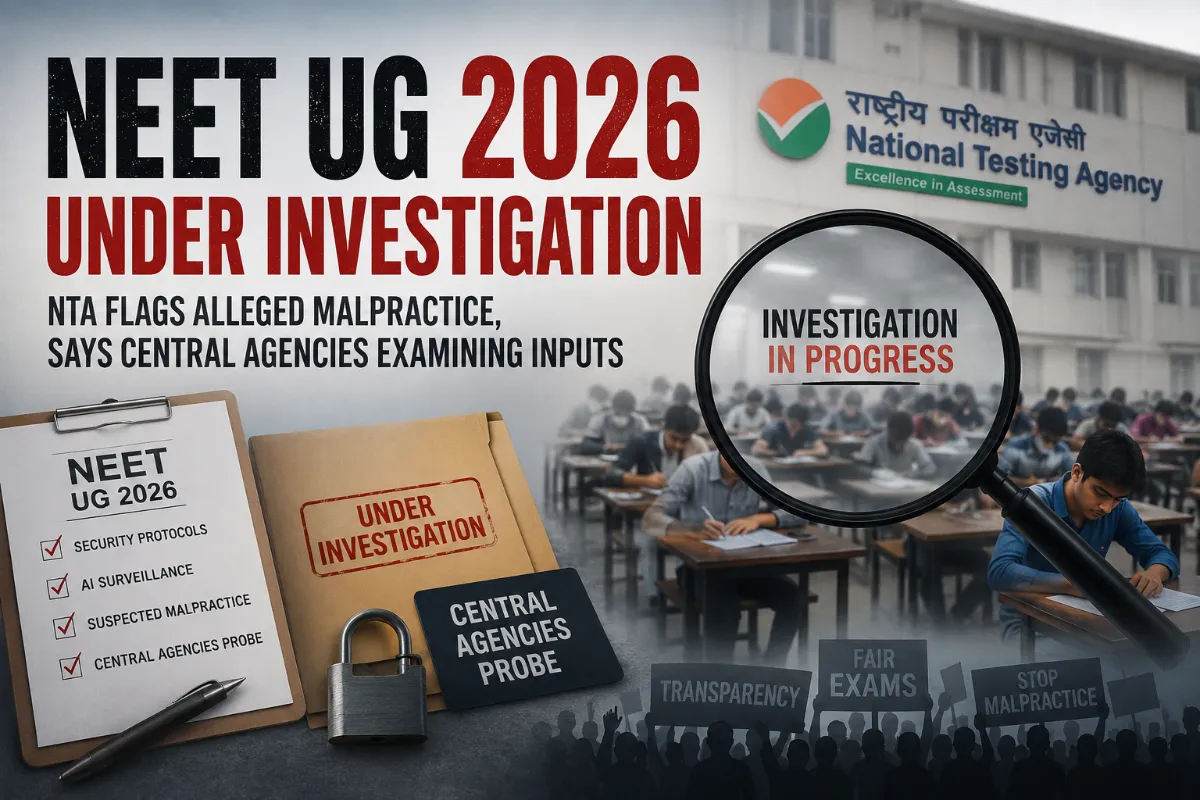
India’s most consequential medical entrance examination, NEET UG 2026, has once again landed in controversy. The National Testing Agency (NTA) has confirmed that inputs pointing to suspected malpractice during the examination were handed over to central investigative agencies on May 8. A disclosure that has sent fresh waves of anxiety through lakhs of aspirants and their families across the country.
For millions of students who have spent years preparing for this single examination – often at great personal and financial cost to their families – the news has come as a deeply unsettling blow.
What Has the NTA Said?
In an official statement, the NTA confirmed that intelligence inputs related to suspected irregularities have been shared with central agencies for examination. The agency maintained that the exam was conducted under “multi-layer security protocols” and added that it would not “pre-judge” the outcome before investigators submit their findings.
Notably, the NTA has not revealed the nature of the alleged malpractice, the number of students under suspicion, or the states where the irregularities are believed to have taken place. The agency has also cautioned students against fake claims about paper leaks and cheating networks that are being circulated rapidly on Telegram and other social media platforms.
Why Every Indian Family Is Watching This Closely
NEET UG is not just another entrance examination. It is the single gateway to MBBS, BDS, AYUSH, and allied medical programmes across India. Every year, over 20 lakh students – from small towns in Bihar and Rajasthan to coaching hubs in Kota and Hyderabad – sit for this exam, carrying with them years of hard work and the hopes of their entire families.
In a country where becoming a doctor remains one of the most aspirational career paths, especially for middle-class and lower-income households, any hint of malpractice does not just affect individual results – it shakes the very foundation of merit-based opportunity in India.
Painful Echoes of the 2024 NEET Scandal
The current controversy is impossible to view in isolation. It brings back painful memories of the NEET UG 2024 scandal – one of the worst examination fraud cases in recent Indian history.
That year, widespread allegations of paper leaks, manipulation of grace marks, and organised cheating syndicates operating across multiple states forced the matter all the way to the Supreme Court. The Central Bureau of Investigation (CBI) was called in. Arrests were made in Bihar and Gujarat. The Supreme Court itself acknowledged that certain students had benefited from leaked question papers. Several candidates who had secured admission to MBBS programmes later had their seats cancelled.
The government was compelled to form expert panels to review examination reforms – a tacit admission that something had gone seriously wrong. Now, barely two years later, the same fears are resurfacing.
AI Surveillance Deployed – But Is Technology Enough?
In an attempt to prevent a repeat of 2024, the NTA reportedly deployed AI-based monitoring systems and extensive CCTV surveillance across examination centres this year. Some candidates were allegedly flagged for abnormal behaviour patterns, repeated movements, and suspected impersonation attempts – and it is these digital flags that appear to have generated the malpractice inputs now under investigation.
However, education experts caution that technology alone cannot dismantle the deeply entrenched examination mafia networks that operate across India. Without stronger administrative accountability, faster legal consequences, and systemic reform, digital surveillance will only scratch the surface of the problem.
NTA’s Credibility Takes Another Hit
This latest episode adds to a growing list of failures that have eroded public trust in the National Testing Agency. From NEET to JEE Main, the agency has repeatedly drawn criticism for lack of transparency, poor crisis communication, technical glitches, delayed clarifications, and what many describe as an inadequate response to organised exam fraud.
Student organisations and education activists are now renewing their demands for an independent audit of examination infrastructure, real-time transparency mechanisms during exams, a strict crackdown on examination mafias, and stronger digital security frameworks that go beyond surface-level monitoring.
What Happens Next? And What Students Must Know?
Central investigative agencies are currently examining the evidence and intelligence inputs shared by the NTA. No conclusions have been announced yet. In the meantime, lakhs of anxious candidates are awaiting official updates on the answer key release and objection window, OMR sheet verification, result timelines, and any corrective action that may follow the ongoing probe.
The NTA has urged all aspirants to rely only on information from official channels and to avoid spreading or acting on unverified claims circulating online.
Millions of careers and millions of families are riding on NEET every year. The outcome of this investigation will not only determine the fate of 2026 aspirants but could also shape the future of examination reform in India. The Jan Post will continue to follow this story closely as it develops.