

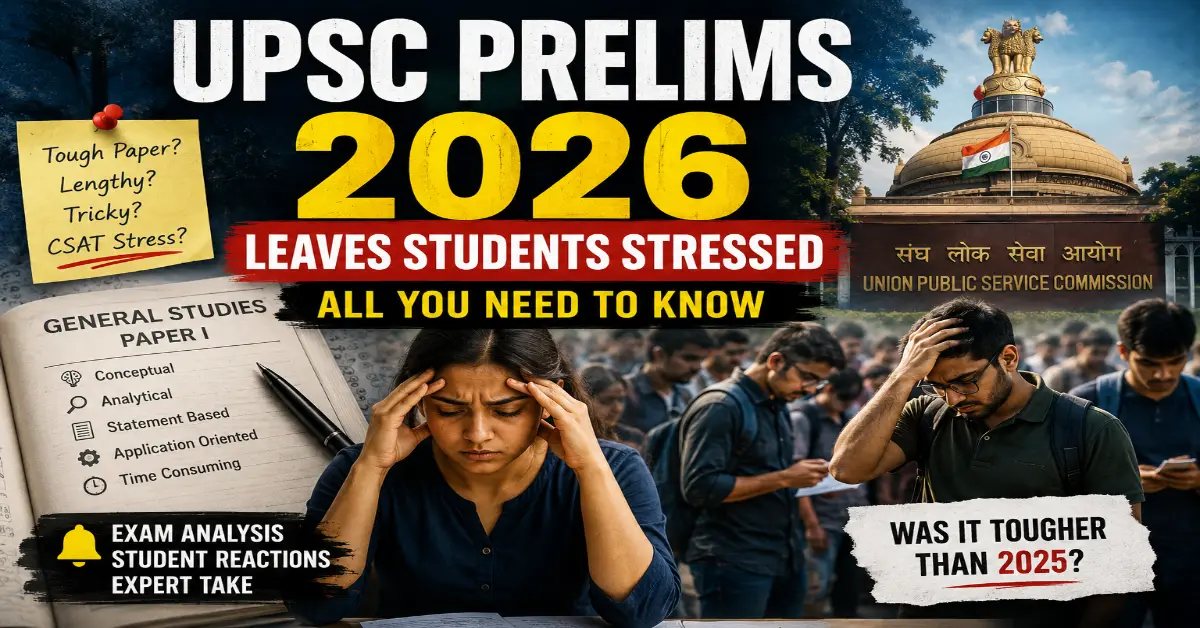
The UPSC Civil Services Preliminary Examination 2026 concluded today amid intense discussions among aspirants, educators, and coaching experts across the country. Soon after the exam ended, reactions began pouring in from examination centres and online platforms, with many candidates describing this year’s paper as “tricky,” “concept-heavy,” and tougher than the 2025 prelims.
From Delhi’s Rajinder Nagar and Mukherjee Nagar to coaching hubs in Prayagraj, Jaipur, Patna, and Hyderabad, aspirants were seen discussing difficult questions, confusing options, and the growing unpredictability of the UPSC pattern.
Was UPSC Prelims 2026 Tougher Than 2025?
According to a large section of students and educators, the 2026 paper felt more analytical and mentally exhausting compared to UPSC Prelims 2025.
While the 2025 paper was considered balanced with a moderate number of direct questions, this year’s General Studies (GS) Paper 1 reportedly focused more on conceptual understanding, statement-based questions, and application-oriented thinking.
Several aspirants said the paper demanded deeper interpretation skills rather than simple memorisation of facts.
“The options were very close. Even after knowing the topic, selecting the correct answer was difficult,” said an aspirant from Delhi.
Another student from Patna described the paper as “UPSC at its unpredictable best,” adding that current affairs were heavily merged with static subjects like Polity, Geography, Environment, and Economy.
Experts believe UPSC continued its recent trend of rewarding analytical ability over rote learning.
Students React: ‘Lengthy, Confusing, and Mentally Draining’
Many candidates who appeared for the exam said the paper was not impossible, but extremely time-consuming.
Students highlighted that statement-based and elimination-oriented questions dominated the paper. Aspirants also noted that several questions required multi-layered understanding and careful reading.
“You could not confidently answer many questions in one go. UPSC created confusion through closely framed options,” said a first-time aspirant outside a centre in Prayagraj.
Another candidate shared that Environment and Science & Technology sections were more difficult than expected.
Social media platforms like X and Telegram quickly filled with discussions around “safe attempts,” expected cut-offs, and surprise topics. Memes and emotional posts from aspirants also reflected the stress and pressure associated with the exam.
CSAT Continues to Trouble Aspirants
The Civil Services Aptitude Test (CSAT), which remains qualifying in nature, once again became a major talking point among candidates.
While some students found the paper manageable, many reported that the comprehension passages were lengthy and reasoning questions consumed significant time.
Several aspirants admitted they underestimated CSAT preparation and struggled with time management during the exam.
“CSAT was not easy at all. Reading comprehension took a lot of time,” said a candidate from Jaipur.
Educators noted that UPSC appears determined to maintain CSAT as an effective screening tool, especially for candidates who ignore aptitude preparation.
What Educators and Coaching Institutes Said
Teachers and coaching institutes across the country released preliminary analyses soon after the exam. Most experts agreed that the overall level of the paper ranged between moderate to difficult.
According to educators, UPSC focused less on factual recall and more on conceptual application. Many also observed that the exam tested patience, risk management, and intelligent guessing techniques.
Faculty members from major coaching institutes suggested that candidates with strong fundamentals and balanced preparation would have an advantage this year.
Experts also pointed out that:
- Current affairs were integrated with static subjects.
- Polity and Economy questions required conceptual clarity.
- Environment and Geography remained important scoring areas.
- Many questions were framed indirectly, increasing confusion.
Expected Cut-Off Discussion Begins
Although official answer keys and cut-offs will only be released later by UPSC, early discussions among coaching institutes suggest that the cut-off may remain close to last year’s levels or slightly lower if the paper is widely considered difficult.
However, educators cautioned aspirants against relying too heavily on unofficial answer keys released immediately after the exam.
Emotional Day for Aspirants
For many students, UPSC Prelims 2026 was not just an examination but the result of years of preparation, sacrifices, and repeated attempts.
Outside centres, reactions ranged from relief and optimism to disappointment and anxiety. Some candidates appeared confident about clearing the prelims stage, while others were uncertain about their performance due to the unpredictable nature of the paper.
With the prelims now over, aspirants are expected to shift focus towards the UPSC Mains 2026 preparation while waiting for the official results and answer keys.