
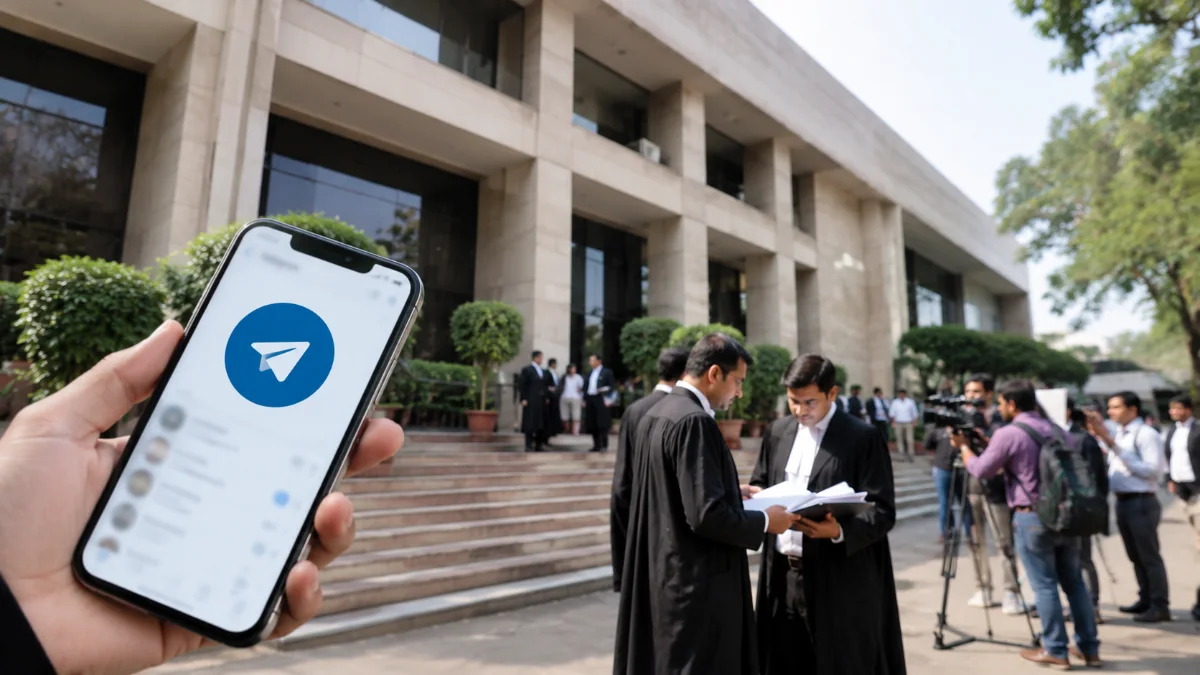
Instant messaging platform Telegram has approached the Delhi High Court challenging the Central government’s decision to ban its operations in India until June 22, citing concerns over the National Eligibility cum Entrance Test – Undergraduate (NEET-UG) re-examinations scheduled for June 21.
Advocate Madhav Khosla mentioned the matter before a vacation bench of Justice Tejas Karia, which agreed to hear it on an urgent basis. Khosla informed the bench that over 150 million users in India have been affected by the ban.
Telegram Calls Ban Unconstitutional
In its writ petition, Telegram has argued that the government singled it out while other social media platforms continued to operate without any restriction, calling this a violation of Article 14 of the Constitution.
“The impugned order proceeds on the impermissible premise that misuse by a subset of users justifies blocking of an entire platform. Such an approach, if upheld, would enable indiscriminate suspension of digital platforms, severely undermining constitutional protections of free speech and access to information,” the company said in its petition.
Telegram further contended that the order was passed without proper application of mind, as it accepted the National Testing Agency’s (NTA) allegations at face value without sharing the underlying material with the platform or acknowledging the steps it had already taken.
Telegram Cites Cooperation With Authorities
The company stated that it had held multiple meetings with government agencies since May and submitted detailed responses outlining its proactive and reactive moderation measures. After receiving specific URLs from authorities on June 9, Telegram claimed to have removed the flagged content within an hour. It also stated that it had taken down over 900 links related to unlawful NEET content and deployed artificial intelligence, machine learning tools and manual moderation to identify and address violations.
Why the Government Banned Telegram
The Ministry of Electronics and Information Technology (MeitY) issued a direction under Section 69A of the Information Technology Act, 2000, restricting access to Telegram in India until June 22. A separate order directed the platform to disable its message-editing feature for already-posted messages until June 30.
The government described the measures as necessary to protect the integrity of the NEET-UG re-exam, arguing that Telegram channels were being used to distribute leaked or fake question papers, coordinate fraud and manipulate message timestamps through the platform’s editing feature.
The ban followed the cancellation of the original NEET-UG examination after widespread allegations of paper leaks and irregularities.