
In Varanasi, the parliamentary constituency of the Prime Minister and one of the world’s oldest living cities, the idea of “development” has increasingly come under scrutiny. Critics argue that the term is often used as a shield behind which encroachments on trust lands, heritage structures, and the sanctity of the Ganga ghats continue to expand. Allegations of silent occupation of old trust properties and heritage buildings have been repeatedly raised by activists and local observers, suggesting that the administrative response has been slow and inconsistent.
The issue becomes more sensitive when seen in the context of Varanasi’s globally recognized cultural and religious heritage. The ghats along the Ganga are not merely architectural spaces but living symbols of India’s spiritual identity. Yet, over the years, concerns have emerged about unauthorized construction and commercialization in riverbank zones, which environmentalists say threaten both ecological balance and historical character.
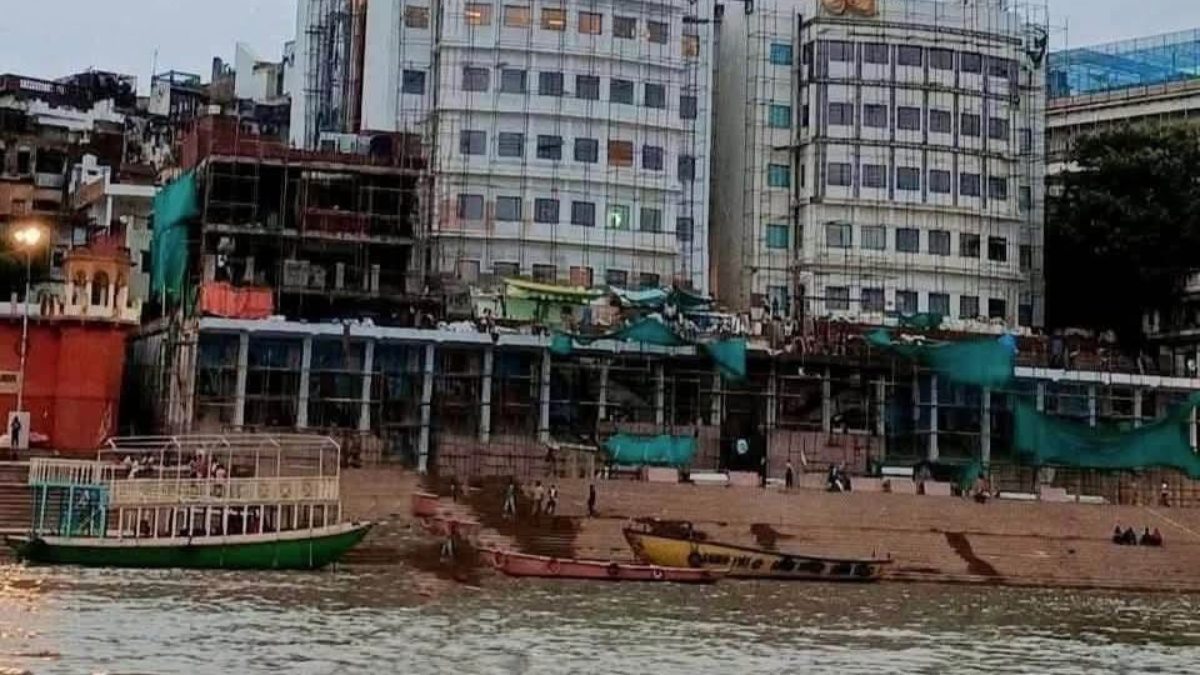
A particularly contentious point relates to construction activities near the ghats, including areas such as Ramghat, where older institutions once served local communities. Reports and local narratives claim that structures that once had public utility have been replaced by large commercial buildings, including luxury hospitality projects. Such developments have raised questions about land-use permissions, zoning compliance, and regulatory oversight by local authorities like the Varanasi Development Authority (VDA).
Legally, the matter is significant. Multiple orders of the Allahabad High Court have emphasized restrictions on construction along the banks of the Ganga. The court has repeatedly directed that no new construction should take place within 200 metres of the riverbank’s highest flood level in Varanasi to protect the river’s ecology and the heritage value of the ghats.
These directives emerged from Public Interest Litigations highlighting a large number of unauthorized constructions along the river, which were seen as a threat to both environmental sustainability and the heritage landscape of the city.
Despite such legal provisions and master plan norms, enforcement has historically been uneven. Official discussions and surveys have acknowledged that several illegal constructions have come up within restricted riverbank zones, even after government orders and court directives.
 Follow TJP Whatsapp Channel
Activists have also alleged in court proceedings that authorities often ignore complaints and allow improper constructions to continue under the guise of renovation or redevelopment.
At the same time, authorities periodically claim to take action against illegal development. For instance, the VDA has announced crackdowns on unauthorized constructions near the Ganga and in protected zones, and demolition drives have been carried out against structures violating riverbank and green belt norms under the city’s master plan.
However, critics argue that such actions are selective and delayed, allowing large-scale commercial projects to flourish while ordinary residents struggle for minor repair permissions.
This contrast fuels public resentment. Local residents often complain that small homeowners face prolonged bureaucratic hurdles—even for renovation – while large projects appear to move forward without visible resistance. The perception of administrative silence or tacit approval has intensified debates about governance and accountability in a city that holds immense religious, historical, and political importance.
Ultimately, the debate over development in Varanasi is not merely about infrastructure but about priorities. When rapid urban expansion intersects with fragile river ecology and centuries-old heritage, the stakes become far higher. The real challenge lies in balancing modernization with preservation – ensuring that economic growth does not come at the irreversible cost of cultural identity, environmental sustainability, and public trust.