
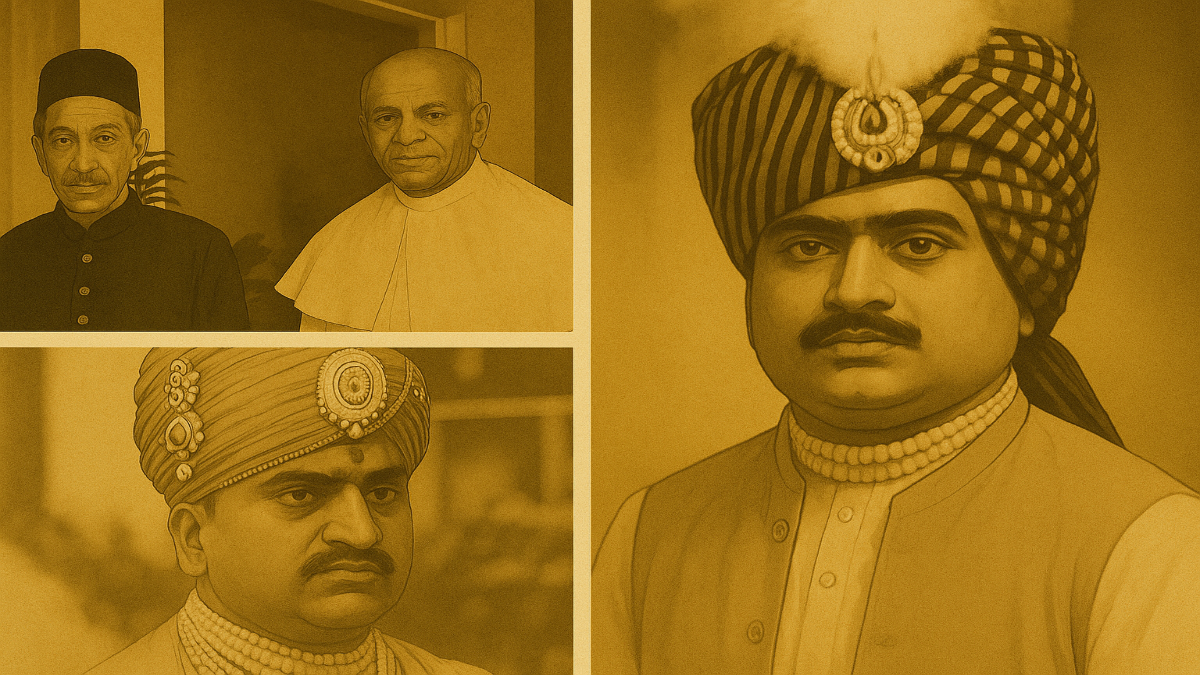
At the time of the country’s partition, 562 out of 565 princely states merged into independent India. However, three states – Junagadh, Hyderabad, and Kashmir – refused to join India and chose to remain independent.
This was their legal right. The last British Governor-General of India, Lord Mountbatten, had established this very principle as part of the arrangement negotiated between India and Pakistan at the time of independence.
Under the Indian Independence Act, 1947 – passed by the British Parliament on 5th July 1947 and granted Royal Assent on 18th July 1947 – two independent dominions, India and Pakistan, were formally created on 15th August 1947. This was the written, legal basis of India’s partition.
The Act contained specific provisions concerning the Indian princely states, designed to protect their sovereignty:
First, British paramountcy over the princely states was formally ended, meaning the states were no longer subject to the British Crown. Second, the states were given the freedom to choose between joining either India or Pakistan, or remaining independent. Third, states were given the right to accede to either dominion through an Instrument of Accession a document by which a state would transfer certain sovereign powers, primarily defence, foreign affairs, and communications, to the chosen dominion, while retaining internal autonomy over its own governance, laws, and administration.
Despite these clear provisions, then Home Minister Sardar Vallabhbhai Patel and V.P. Menon adopted a strategy of pressure and persuasion to bring the princely states into India and succeeded in securing the accession of 562 states.
 Follow TJP Whatsapp Channel
Yet three states held out: Junagadh, Hyderabad, and Kashmir. Of these, two Junagadh and Hyderabad were ruled by Muslim rulers, while Kashmir was ruled by a Hindu king.
Hyderabad
Hyderabad, though home to a population that was 85% Hindu, was under the rule of Nizam Mir Osman Ali Khan – one of the wealthiest and most powerful rulers in India. The state occupied the Deccan plateau and covered territories that today form large parts of Telangana, Andhra Pradesh, Maharashtra, and Karnataka.
The vast Hindu majority of the state wished to join India. To suppress this sentiment, a private militia known as the Razakars led by Qasim Razvi of the Majlis-e-Ittehadul Muslimeen (MIM) unleashed violence and oppression against the Hindu population, brutally silencing voices that favoured accession to India.
The Nizam also took the matter to the United Nations and attempted to establish Hyderabad as an independent constitutional monarchy within the British Commonwealth. Ultimately, however, he relented.
In response to the situation on the ground, Sardar Patel launched Operation Polo on 13th September 1948 – barely a year after British rule had ended – in direct contravention of the Indian Independence Act, 1947. The operation concluded on 18th September 1948, and Hyderabad was forcibly merged into the Indian Union. Lakhs of people lost their lives in the process.
Junagadh
Junagadh presented a similar picture. The state had a predominantly Hindu population, but its ruler, Nawab Muhammad Mahabat Khan III, chose to exercise the rights granted under the Independence Act and decided to accede to Pakistan — against the wishes of his own people.
In response, India carried out a military intervention – Operation Junagadh – in 1947, and the state was absorbed into the Indian Union.
Both of these military actions were in direct violation of the Indian Independence Act, 1947. Yet because they served India’s interests, few questioned their legality or ethics. Nobody seemed troubled by the fact that India had broken a treaty barely a year old and forcibly merged two independent states through military force. The actions were accepted with enthusiasm, and Sardar Patel was celebrated as the “Iron Man of India” for precisely this reason.
Kashmir
The third state that refused to accede to India was Kashmir – where the population was predominantly Muslim but the ruler, Maharaja Hari Singh, was Hindu. Despite being a Hindu, Hari Singh was not in favour of joining India. He wished to keep Kashmir independent, envisioning it as a Switzerland of the East.
Crucially, unlike Junagadh and Hyderabad, the Muslim-majority population of Kashmir was not opposed to their ruler’s position — they stood with him. Had Pakistan-backed tribal militias not invaded, it is quite plausible that Kashmir might be an independent nation today.
It was the tribal invasion that panicked Maharaja Hari Singh into seeking India’s help. India offered assistance in exchange for accession, and the Maharaja signed the Instrument of Accession under Section 3 of the Indian Independence Act, 1947 transferring control of defence, foreign affairs, and communications to India while retaining internal autonomy. This arrangement was, in essence, what became Article 370.
Here lies an important and often overlooked point: despite surviving for three years after Kashmir’s accession, Sardar Patel never launched an Operation Polo or an Operation Junagadh-style military action to achieve Kashmir’s full and unconditional integration. He did not, or could not.
Yet it is Jawaharlal Nehru who is blamed for the Kashmir problem, while Sardar Patel is celebrated as the Iron Man for his military actions in Hyderabad and Junagadh.
The Whole Truth
The reality is that the diplomatic and strategic success of integrating India’s princely states was the result of the combined efforts of both Prime Minister and Foreign Minister Jawaharlal Nehru and Home Minister Sardar Patel – two leaders who worked together to achieve something that defied a law passed by the then superpower England in its own Parliament.
People tend to see Nehru and Patel as opposites, even rivals. But could Sardar Patel, who served under Nehru’s government, have taken any major action without the Prime Minister’s consent? Given the nature of their relationship and the conventions of Cabinet governance, the answer is clearly no.
The two men would discuss every matter together – agreeing on some things and disagreeing on others. That was entirely normal. But when they disagreed, neither called the other a traitor, and neither sent the other to gaol.
In the end, the Indian Independence Act, 1947 was reduced to little more than a line drawn between India and Pakistan. Every right it granted to the princely states was taken away – by force, by pressure, and by the political compulsions of a newly independent nation finding its feet.
(The article presents a historical analysis of the accession of Junagadh, Hyderabad, and Kashmir into the Indian Union and the legal and political complexities surrounding these events.)