

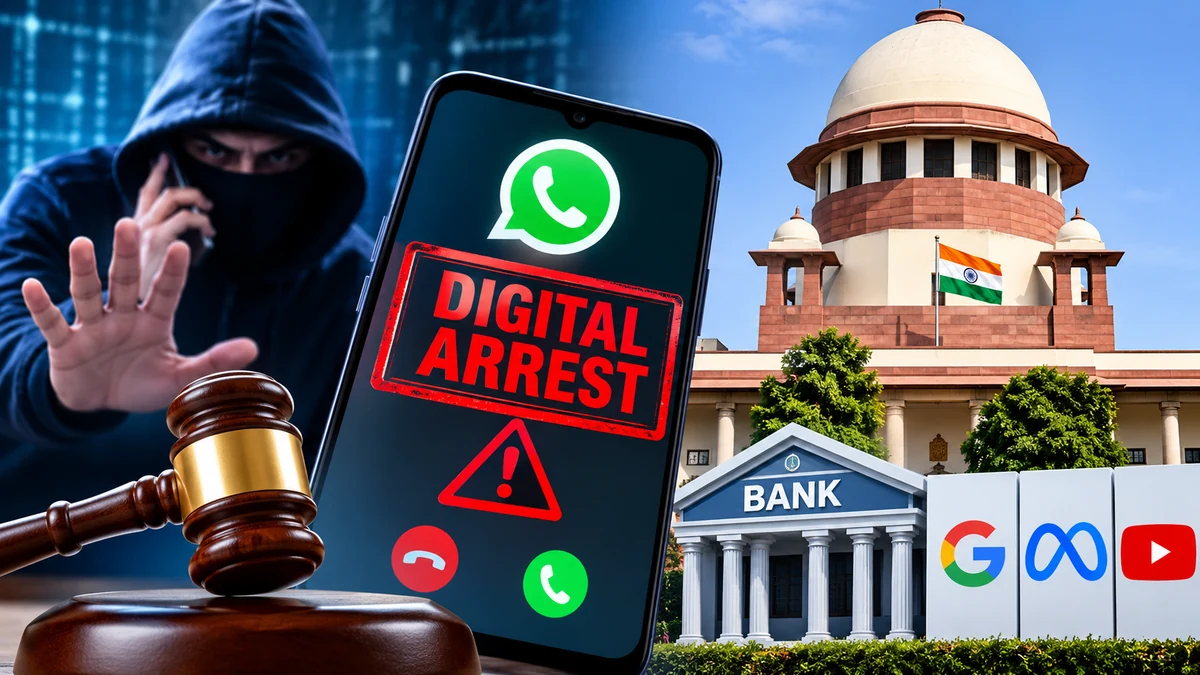
NEW DELHI: The Supreme Court has asked WhatsApp and other online platforms to tell it how they plan to stop digital arrest scams, and has signaled that banks could be made to repay victims.
The platforms must send their proposals to the Indian Cybercrime Coordination Centre (I4C). The court will take up the matter again Nov. 23.
A bench of Chief Justice Surya Kant and Justices Joymalya Bagchi and V Mohana issued the directions in an order uploaded to the court’s website. The case is titled “In Re: Victims of Digital Arrest Related to Forged Documents.”
WhatsApp’s response
Senior advocate Kapil Sibal, appearing for WhatsApp, told the court the company has already acted against 9,400 accounts. He said WhatsApp will file an affidavit describing its measures and is building software to flag suspicious accounts and warn users.
Banks under scrutiny
At an Oct. 29 hearing, the court said financial institutions must be held accountable for digital arrest scams and other cyber fraud. Banks should compensate customers when an investigation shows the institution failed to exercise due diligence, it said.
The bench said rules proposed by the Reserve Bank of India (RBI) must require banks to indemnify victims. Compensation, it said, should be no less than the amount lost where the fraud resulted from a bank’s failure to prevent or report it.
The Chief Justice questioned why banks did not step in when customers suddenly tried to transfer unusually large sums that did not match their usual transactions.
The court said earlier that banks should be required to take certain steps. These include temporarily suspending transactions that do not fit an account’s history, automatically alerting the nearest police station and physically verifying the transaction.
The bench said cybercrime cases have fallen by 50%, but victims have still lost Rs 800 crore this year. It said the RBI’s framework must include enforceable rules on compensation, early intervention and institutional accountability.
The Chief Justice described banks as a “protective umbrella” for vulnerable customers. He said they hold customer data and transaction histories and should use them to stop fraud before money leaves an account.
RBI rules and deadlines
The court said it will first examine the RBI’s draft Know Your Customer Amendment Directions, 2026, before they can go ahead. The directions are proposed to be notified by Nov. 30 and take effect by Dec. 31.
The RBI has been told to submit a list of all authorised financial institutions at the next hearing.
Attorney General R Venkataramani, appearing for the Centre and other authorities, told the bench that substantial work has been done to improve detection of suspicious transactions and strengthen banking safeguards, PTI reported.
Police reports ordered
The bench directed law enforcement agencies in all states and Union territories to file reports on first information reports registered in digital arrest cases and the resulting investigations. The agencies must also suggest ways to prevent, detect and prosecute such offenses.
Directors general of police must ensure compliance. The reports go to the inter-departmental committee coordinating the government’s response, and reports filed earlier must be sent to it as well.
The court will next review the platforms’ proposed safeguards, the RBI’s rules and the police reports.